


Advantages of Infrared Monitoring Technology in Clinker Production
The Ideal Solution in the Cement Industry - Thermal Cameras for Clinker Cooling Process
Challenge
Clinker cooling requires precise temperature control to avoid delays and inefficiencies, yet visual checks are unreliable in dusty, high-heat environments, risking premature or delayed process steps.
Solution
Continuous, real-time thermal imaging enables accurate clinker temperature monitoring throughout the cooling phase, improving timing and control even under extreme environmental conditions.
Benefits
- Accurate timing of clinker transfer improves process flow and reduces delays
- Real-time monitoring minimizes manual checks and operator workload
- Enhanced process control leads to lower energy consumption and fewer inefficiencies
- Reliable data ensures consistent clinker quality for downstream processing
- Faster decision-making helps reduce operating costs and increase throughput
Challenges of Temperature Measurement in the Clinker Cooling Process
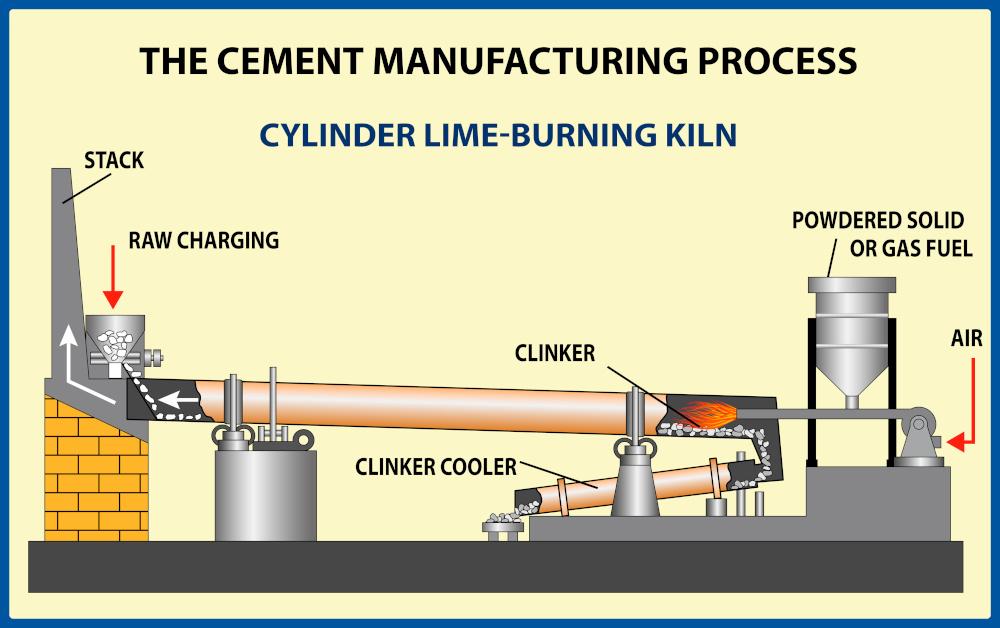
The clinker production process places high demands on temperature monitoring, especially during the cooling phase. Clinker, which is fired in a rotary kiln at temperatures of up to 1450 °C (2642 °F), must be cooled to below 200 °C (392 °F) before it can be further processed. Monitoring this process has been a challenge for many clinker manufacturers, as conventional visual systems cannot provide accurate information about the material’s temperature. In the past, clinker was monitored visually at many manufacturers, which often led to inefficient and time-consuming processes. Long cooling phases without feedback on the actual material temperature caused delays and suboptimal process management. Frequently, experienced employees manually checked the temperature and only then initiated the next process step.
The need to more accurately control the cooling process arises from the fact that clinker is only ready for the next processing step at optimal temperatures. Without precise temperature data, there was a risk that the clinker was transferred to the next stage either too early or too late, resulting in additional costs and time loss. The challenge was to find a solution that allowed for accurate temperature measurement in the dusty and extremely hot environment of the clinker cooler. Monitoring the cooling process through precise temperature measurement is therefore essential for optimizing the process and increasing efficiency.

Integration of the Solution – Monitoring the Cooling Process in Real Time
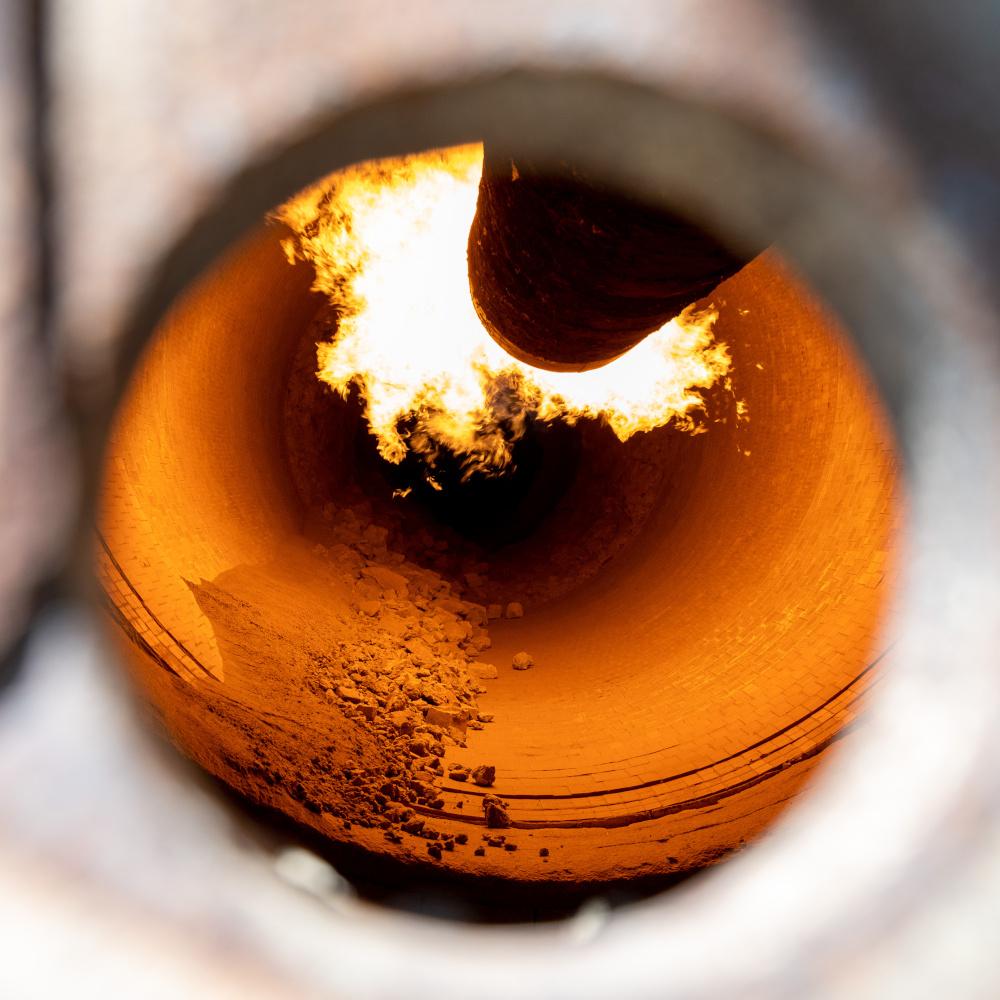
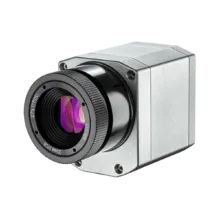
The technical implementation of temperature monitoring in the clinker cooling process by Optris was achieved through the use of the PI 1M, a state-of-the-art infrared camera with a wide measurement range from 450 °C to 1800 °C (482 °F to 3272 °F). This fixed installed infrared camera is particularly suitable for high-temperature processes, such as those encountered during clinker cooling. Thanks to its special CMOS detector and high resolution of up to 764 x 480 pixels at 32 Hz, the camera provides precise thermal images even in challenging environments. The high frame rate of up to 1 kHz also allows for the monitoring of fast processes. Due to its compact design and robust cooling housing (Cooling Jacket Advanced), the thermal camera can be reliably used even in ambient temperatures of up to 70 °C (158 °F).
A key advantage of the PI 1M is its short wavelength of 0.85 µm – 1.1 µm, which enables the camera to operate through a borosilicate viewing window and observe the clinker cooler. This ensures continuous monitoring of the material’s cooling. The infrared imaging camera can simultaneously capture the temperature of the clinker at several measurement points. With the included PIX Connect software, up to eight or more measurement areas can be defined, whose temperature data is captured in real-time and transmitted to the control system via analog outputs. This allows precise control of the cooling process, with the measured temperatures having an accuracy of ±1%.
Additionally, the thermal camera offers real-time analog output with a response time of just 1 ms, allowing for rapid adjustments to the process if necessary. Connection to the central monitoring system is via Ethernet, ensuring stable and fast data transmission. Through this precise temperature monitoring, the entire clinker cooling process is significantly optimized.
Time and Cost Savings through Process Optimization of Clinker Cooling
Using the PI 1M infrared camera has significantly improved the clinker cooling process and provided clinker producers with crucial advantages. Thanks to precise temperature measurement, the process can be accurately monitored and adjusted when necessary. This leads to significant time savings, as the clinker can now be processed at precisely the right moment without unnecessary delays. The real-time monitoring and high frame rate of up to 1 kHz ensure that even rapid temperature changes are immediately detected. This was impossible with conventional visual systems, which only provided images but no accurate temperature data.
The camera has a thermal sensitivity (NETD) of less than 2 K at temperatures below 900 °C (1652 °F) and less than 4 K at temperatures below 1400 C. This high sensitivity allows for the exact detection of temperature differences, even in dusty and challenging environments, such as in the clinker cooler. Additionally, the camera is well protected from external influences thanks to the protective housing and the laminar air purge, which continuously keeps the lens dust-free.
Another advantage of the solution is the excellent price-performance ratio that clinker manufacturers have achieved by integrating the PI 1M infrared camera. The high precision, robust design, and easy integration into existing processes make the IR camera ideal for clinker cooling. The ability to define and monitor multiple measurement areas and transmit this data in real-time ensures optimal process control. This leads to cost savings as the process runs more efficiently, eliminating unnecessary steps. The thermal camera has thus proven reliable for optimizing the clinker cooling process.
Recommended Products





Other General Manufacturing Applications




Talk to us about your IR Temperature Measurement Requirements
There are over 300 different pyrometer variants to choose from in the Optris infrared pyrometer portfolio each optimized for material, spot size, distance from the target, and environmental conditions. Fortunately, there is a trained engineer to phone or chat with to guide you through the process of choosing the perfect infrared sensor for your application.
The same support is available for the extensive IR camera product line.
