


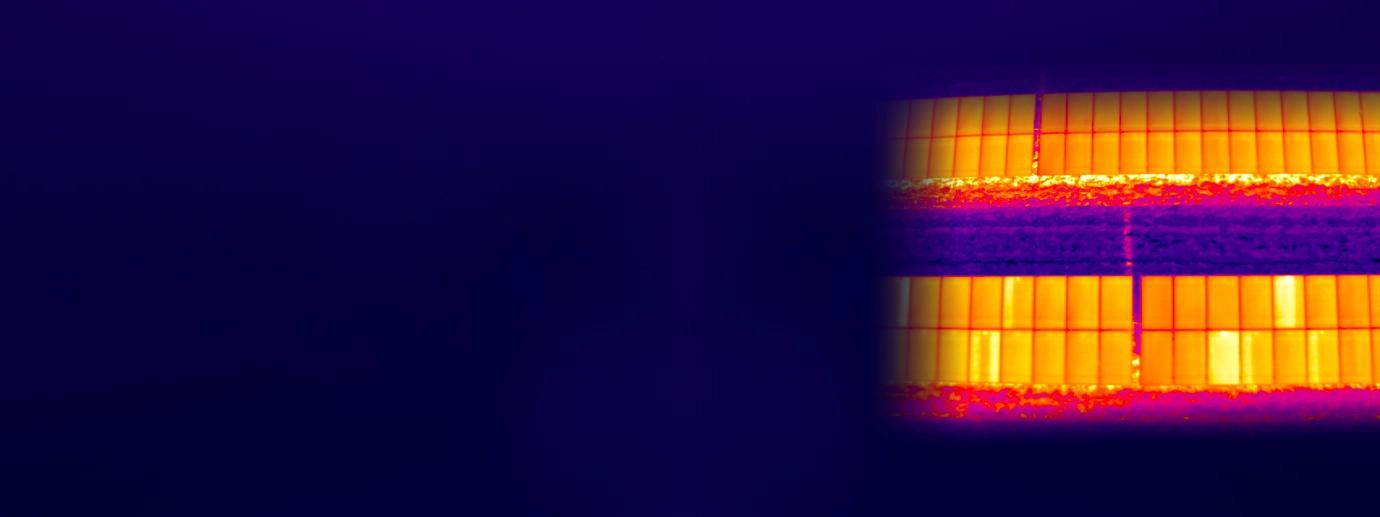
Steady State Thermography for Non-Intrusive Solar Module Defect Detection
Thermographic Inspection of Internal Short-Circuits, Delamination, Cell Mismatch, Cracks and Defective Bypass Diodes of Solar Cells
Challenge
Defective solar modules can go undetected during production and operation, leading to performance loss, safety risks, and reduced lifespan. Traditional detection methods are slow, intrusive, and inefficient for large-scale inspections, making it difficult to identify hidden defects like microcracks, delamination, or cell mismatches in real time.
Solution
Thermal imaging under steady-state illumination enables fast, non-contact detection of thermal anomalies linked to defects. By analyzing temperature differences across PV modules during various operating states, IR thermography identifies issues such as hot spots, bypass diode failures, and internal shorts, supporting proactive and non-destructive quality assurance.
Benefits
- Enhances early defect detection before severe performance degradation occurs
- Enables real-time, non-intrusive quality control during production and field inspections
- Supports predictive maintenance and extends module operational lifespan
- Reduces safety risks by identifying hotspots and electrical faults early
- Minimizes downtime and energy losses through fast fault localization and prioritization
Optimizing Solar Module Performance and Lifespan via Rapid Non-Intrusive Early Defect Detection
To achieve sustainable and reliable electricity generation from solar energy, it is commercially essential to extend the lifespan of photovoltaic (PV) modules while reducing costs. The cost per unit of energy a PV module produces is influenced by the average solar irradiance at the installation site, the module’s lifespan, and its purchase price. Additionally, significant costs arise from incomplete quality control during the production, post-installation, and operational phases of PV modules.
During production, some defective PV modules may go undetected and be deployed, leading to potential performance degradation and safety hazards during operation. Conventional methods for detecting defective solar modules, such as individual or string-level current-voltage (I-V) curve measurements under sunlight, are time-consuming and labor-intensive, requiring each string or module to be individually connected to the measurement device.
In high-volume production, there is a need for a method that allows for rapid, non-intrusive, and large-scale inspection of PV modules without disrupting the electrical circuit. Identifying primary issues like delamination, where the separation of layers within the module creates air gaps that reduce thermal and mechanical stability, leading to further degradation and potential failure, is crucial. Adhesion loss, where the bonding between different layers weakens or fails, compromises the structural integrity and ability to withstand environmental stresses. Moisture ingress, which can lead to corrosion of electrical components, short circuits, and reduced insulation resistance, severely impacts the module’s performance.
Cell mismatch, where individual cells within a module do not perform uniformly due to variations in manufacturing quality or damage, reduces efficiency over time. Cracks in solar cells, whether micro-cracks or substantial fractures, must be detected as they propagate over time, leading to significant performance losses or even complete module failure.
Detecting defective bypass diodes or internal short circuits is crucial because these issues can significantly impair module performance and longevity. Bypass diodes protect solar cells from damage caused by partial shading, but if defective, they lead to overheating, thermal hotspots, and potential fire hazards. Internal short circuits disrupt the flow of electricity, reducing the module’s efficiency and potentially causing further electrical failures. Identifying these defects early helps maintain optimal energy output, prevent safety risks, and extend the overall lifespan of the solar module.
Effective and fast quality check processes for quality assurance in PV module production and during operation are even more important as the price pressure and liability risks increase.
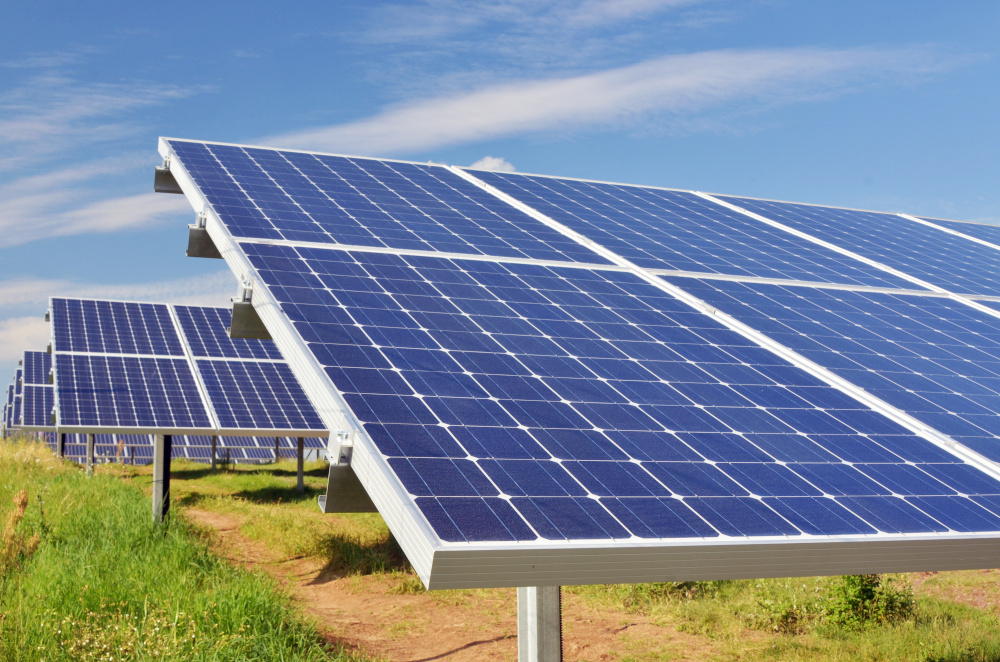
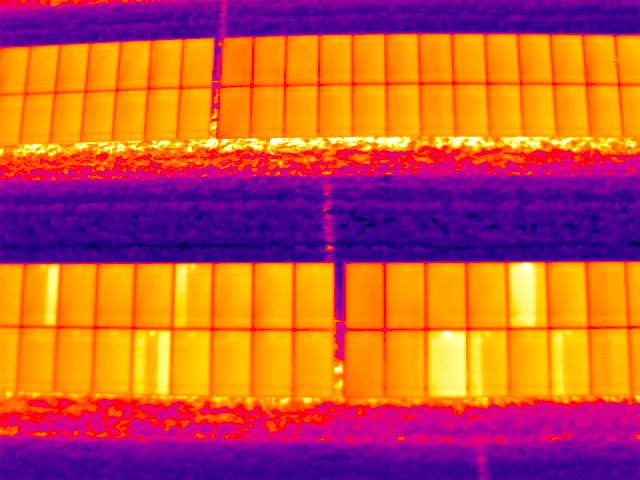
Infrared Thermography With Steady State Illumination for Defect Detection in Photovoltaic Modules
Each imperfection, defect, or anomaly has a distinct thermal fingerprint, allowing them to be identified and visualized with infrared (IR) cameras. Consequently, IR cameras are employed for monitoring and quality assurance of PV modules and other system components at various stages, including final production inspection, module assembly and commissioning, and regular field maintenance. A thermal imaging camera with an uncooled long-wave infrared camera is ideal for the non-destructive inspection of PV modules. It enables quick localization of defects, with diverse application possibilities. Selecting the appropriate lens (wide-angle, telephoto, macro) based on the measurement task is crucial. A detector resolution of 80 x 80 pixels is sufficient, but a higher resolution is recommended for larger areas and detailed investigations. Thermal sensitivity should be at least 100 mK.
Meaningful steady-state infrared measurements, IR images, are only possible with a radiation intensity of at least 700 W/m² at the module level. Otherwise, the IR image contrast is too low. Additionally, avoiding airflow across the solar module surface is essential, as it causes convective cooling and reduces the thermal gradient.
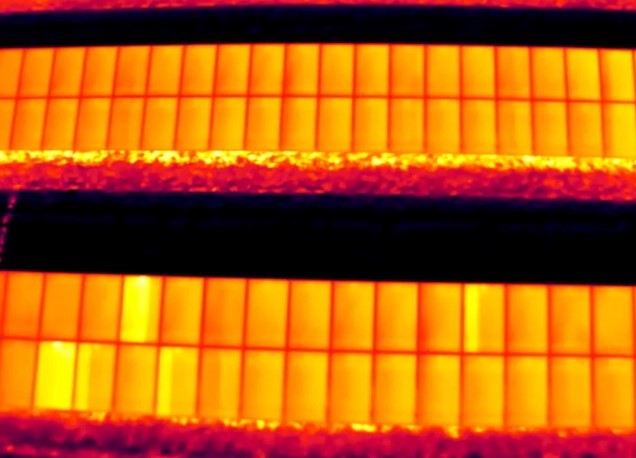
During IR inspection, modules are examined in different operational states: open circuit, short circuit, and under load. Each state can reveal different types of defects. For instance, a uniform temperature distribution is expected in an open circuit, while localized hotspots may appear in a short circuit or under load, indicating issues such as cell mismatches, defective bypass diodes, or internal short circuits.
The actual temperature of the module’s front glass is measured, which should correspond to the cell temperature when measured on-site. Comparing an IR image of the module’s back can help verify temperature distribution consistency. An emission coefficient of 0.85 – 0.90 can be set for IR cameras with uncooled detectors, applicable to all non-metals, including glass. The angle of incidence is crucial for IR measurements, with the optimal IR image being perpendicular to the object. Angle-dependent measurement errors become significant at deviations greater than 30° from the module normal. Multiple reflections must be considered and avoided, as glass reflections are specular and can show surrounding objects clearly in the thermal image, potentially causing misinterpretations and measurement errors.
IR images typically show higher temperatures in anomalous areas than adjacent areas because defects dissipate solar energy as heat rather than converting it to current. More serious defects exhibit higher temperature differentials, with many manufacturers considering a differential greater than 20 degrees as evidence of a defective module. Thermal anomalies with smaller differentials, especially less than 10 degrees, may not require immediate attention but generally indicate ongoing degradation of the solar cells. An IR image showing a hotspot in the PV module can indicate partial shading due to soiling or a cell crack triggering local heating. Therefore, the correct interpretation of IR images and identifying the supposed causes individually are crucial.
Radiometric IR Cameras and high Sensitivity for Accurate Anomaly Detection of Solar Modules
Each type of anomaly, such as hot spots, cell mismatches, and bypass diode failures, has a distinct thermal signature that can be detected using infrared cameras. To accurately quantify these temperature differences, assess the severity of anomalies, and prioritize their handling, the use of a radiometric infrared camera is highly recommended. Only radiometric IR cameras capture and store precise thermal data at each pixel, accurately identifying and quantifying temperature anomalies.
For example, a single-cell hot spot can be classified into different priority levels based on the temperature differential compared to adjacent areas. A cell with a temperature anomaly of less than 10 °C (50 °F) higher than its surroundings might be considered low priority, while a differential of 20 °C (68 °F) or more indicates a high-priority issue requiring immediate attention. Such temperature variations can signal underlying problems like internal short circuits, cracking, or delamination, leading to significant energy losses and potential safety hazards if left unaddressed.
Temperature measurements are also crucial for distinguishing between the severities of similar anomalies. For instance, a hot spot in a junction box or a string anomaly can be categorized into low, medium, or high priority based on the observed temperature increase. This classification helps in prioritizing maintenance efforts, ensuring that the most critical issues are addressed promptly to maintain the efficiency and safety of the solar power system.
Accurate temperature measurement and low NETD aids in the early detection of gradual degradation processes over time. Thermal anomalies with smaller temperature differentials, though not immediately alarming, indicate ongoing deterioration that could worsen over time. Regular monitoring allows for timely interventions, preventing minor issues from escalating into major faults and ensuring the long-term reliability and performance of the PV modules.
Recommended Products
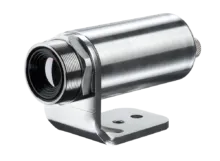





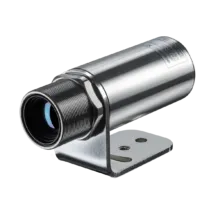


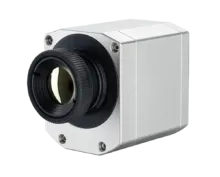



Talk to us about your IR Temperature Measurement Requirements
There are over 300 different pyrometer variants to choose from in the Optris infrared pyrometer portfolio each optimized for material, spot size, distance from the target, and environmental conditions. Fortunately, there is a trained engineer to phone or chat with to guide you through the process of choosing the perfect infrared sensor for your application.
The same support is available for the extensive IR camera product line.
