


Absorption
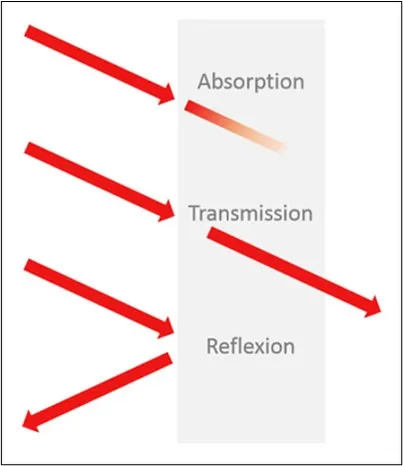
Electromagnetic radiation interacts with matter in three main ways: it can be reflected or diffusely scattered, transmitted through transparent objects, or absorbed. These interactions are described by the absorption (α), reflectivity (Ï), and transmissivity (Ï„) of the material, which are related by the equation: 1 = α + Ï + Ï„. The absorption of radiation represents the portion of energy converted into other forms, such as heat or chemical energy, within the material. It is a unitless ratio variable, ranging from 0 (no absorption) to 1 (complete absorption). The absorption depends on the material’s wavelength-dependent extinction coefficient, the length of the beam path in the material, and the density or concentration of the absorbing material.
For black bodies, all incident light is absorbed, and there is no reflection or transmission. Kirchhoff’s law of thermal radiation states that for a body in thermal equilibrium, absorption equals emission.
In the case of objects that emit and absorb electromagnetic radiation in a narrow wavelength interval, their temperature can still be determined using a suitable narrow-band spectral filter. For example, thin plastic films mainly interact with infrared radiation in the C-H stretch and bending vibration range around 3.4 µm, while flame gases such as CO2 or CO interact strongly in the spectral range around 4.2 µm or 4.6 µm. Selecting appropriate measuring devices is crucial, as some may intentionally suppress the absorption and emission of gases to focus on background radiation.
Back to Lexicon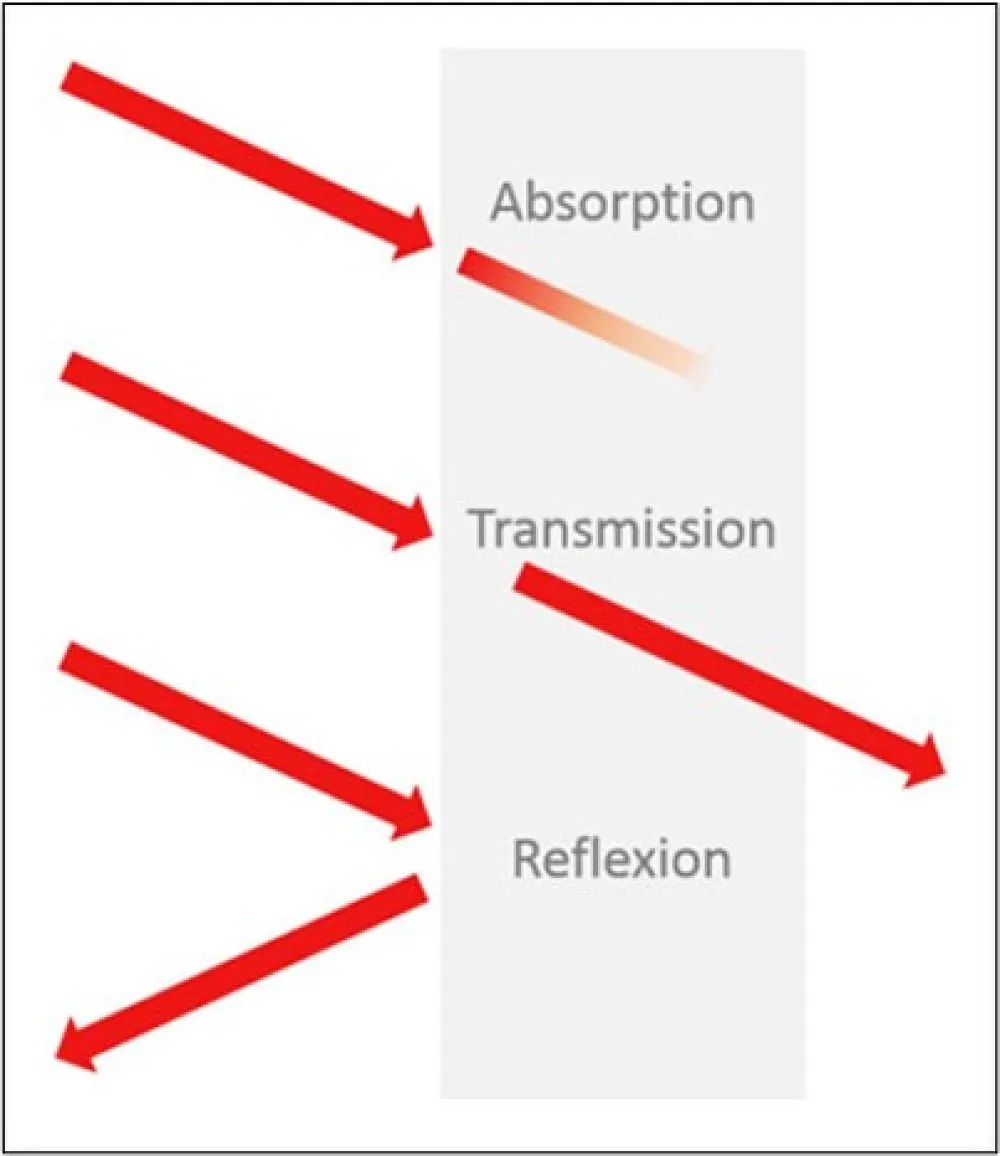
Recommended Products










Talk to us about your IR Temperature Measurement Requirements
Our Infrared Temperature Measurement experts can help you find the right Optris product for your application.
