


Diffraction-Limited System
In optics, a diffraction-limited system achieves the highest optical resolution possible, determined by the behavior of light diffraction. Such a system eliminates optical aberrations and sets the standard for the best possible optical resolution. Instead of producing a sharp point-like image, it creates a diffraction pattern known as the Airy disk. The properties of this pattern depend on the wavelength of the light used (waveband) and the F-number N of the optical system.
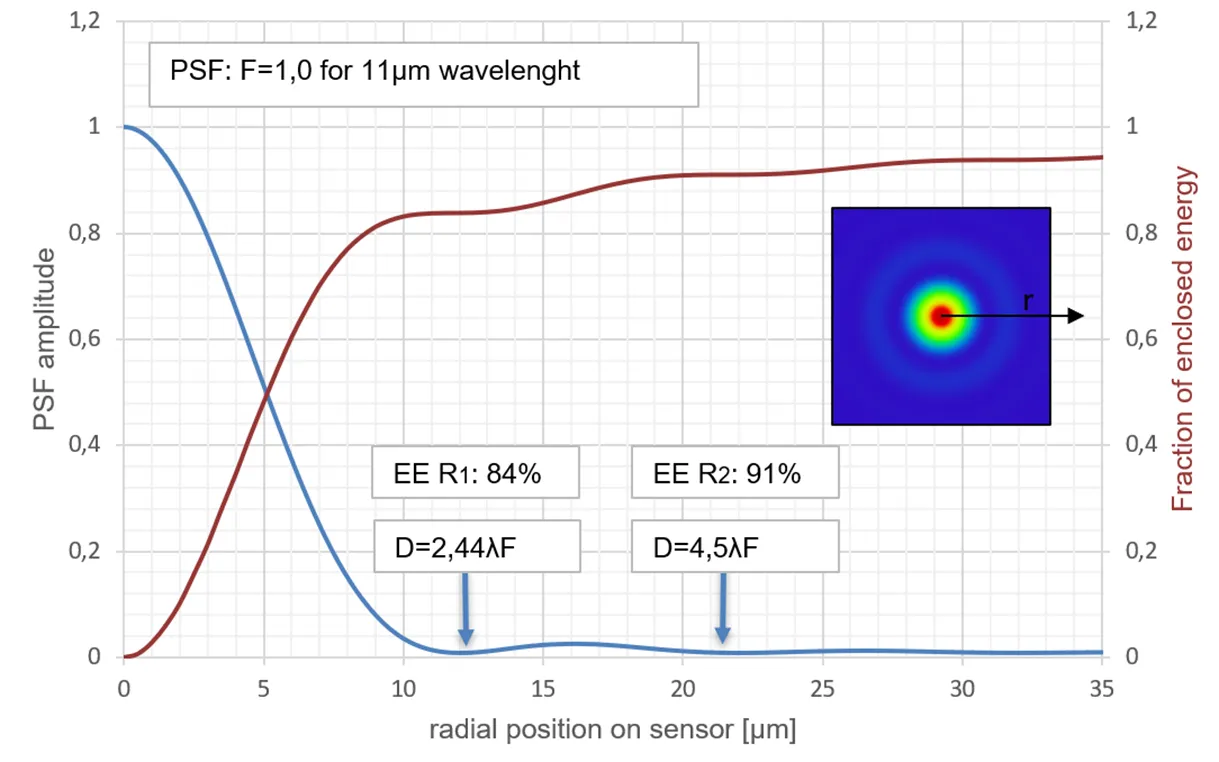
In thermal imaging, diffraction often influences the image quality captured on the camera sensor, especially as pixel sizes decrease and the long wave infrared (LWIR) waveband of 8 µm -14 µm is used. The goal of focusing a point-shaped target onto a detector plane is to focus the radiation onto a point that is smaller than the pixel size. The diameter of the Airy disk can be estimated by the formula d=2.44∙λ∙N, where the diameter is defined by the first zero point of the Airy disk, containing 84% of the target’s encircled energy.
An optical system with minimal aberrations is referred to as a diffraction-limited system. The Strehl ratio quantifies optical quality in real systems, where a ratio of 1 indicates aberration-free optics systems. A Strehl ratio between 0.8 and 1 signifies that diffractive effects dominate and aberrations are negligible. When the Strehl ratio falls below 0.8, optical aberrations become increasingly relevant. In imaging systems, the Modulation Transfer Function (MTF) is often compared against the diffraction limit to classify performance quality. Optical designers aim to approach this limit value as closely as possible, given reasonable material and manufacturing costs.
In thermography, the typical preferred waveband is usually 8 µm -14 µm for measuring objects at room temperature (T=300 K), as dictated by Planck’s law characterizing the emission spectrum of a blackbody. Thermal imaging is limited to the LWIR waveband, commonly used to measure low temperatures. Enhancing optical performance is primarily achieved through a low F-number, ensuring higher optical resolution and reduced aberrations. A competitive optical system combines a low F-number (which correlates with high optical resolution and favorable NETD) with a diffraction-limited system. Achieving this balance is critical for accurate temperature measurements, particularly in applications involving small targets or requiring precise image detail capture.
Back to Lexicon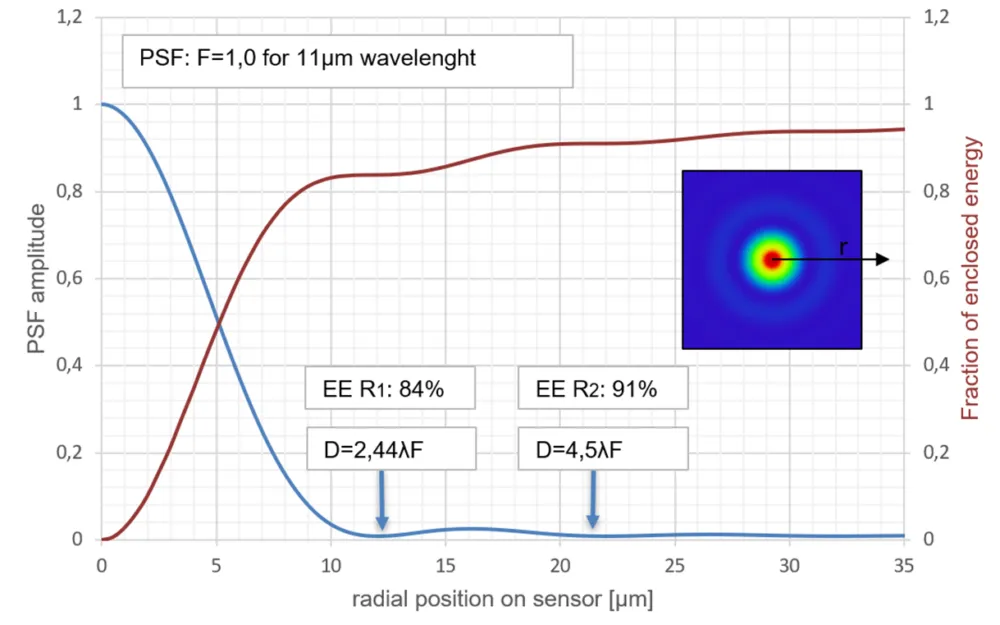



Talk to us about your IR Temperature Measurement Requirements
Our Infrared Temperature Measurement experts can help you find the right Optris product for your application.
