


D:S
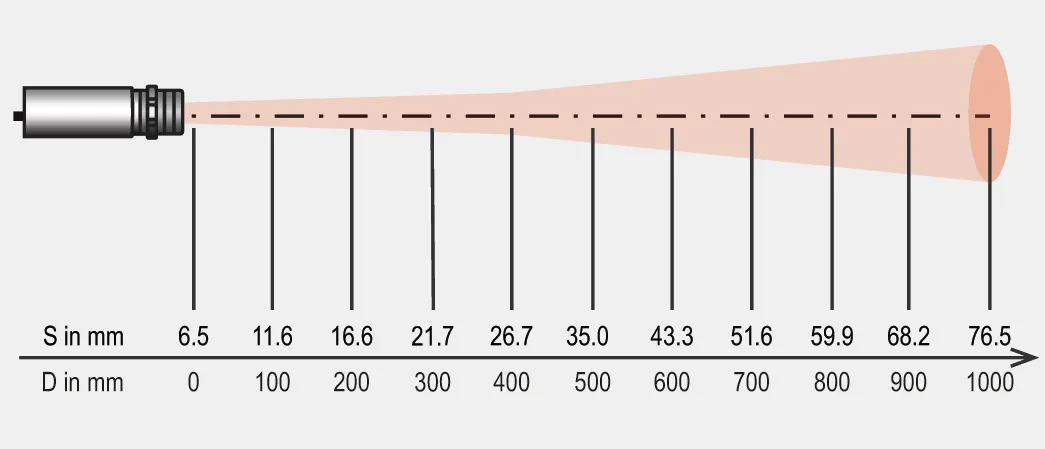
The distance-to-spot size ratio (D:S ratio) is a widely used metric for describing the optical resolution of temperature measurement instruments, such as thermometers or thermography cameras. It is calculated by dividing the measurement distance (focal distance) D of the target by the measurement spot size. The D:S ratio value can be used to determine the measurement spot of the device at a specific distance. For highly accurate temperature measurement, the target size should be at least equal to the size of the measurement spot. This ensures that the measurement device detects at least 90% of the energy of the target if the target is exactly the size of the measurement spot.
In devices with adjustable focus, a single D:S ratio is applied for the full measurement range. Although the spot size increases with distance, the ratio remains constant. Conversely, in fixed focus devices, such as compact pyrometers, the D:S ratio is given only for a certain focal distance. Shifting the target out of focus decreases the D:S ratio, leading to a larger measurement spot and potential temperature deviations.
From an optics point of view, the D:S ratio is related to the focal length F and detector size d of the measurement device. A longer focal length results in an enhanced D:S ratio, but also typically leads to a larger dimension of the measurement device. Compact devices often have more moderate D:S ratios, which can be useful in applications where the target object is large and needs to be tested in its entirety, taking an average temperature measurement over the total size of the object.
For thermal imaging cameras, the concept of the minimum spot size is common. Each pixel out of the detector array represents a potential measurement spot, defining the instantaneous field of view (IFOV). High accuracy in temperature measurement often requires more than one pixel, capturing a measurement field of view (MFOV) usually encompassing 3×3 pixels. This MFOV is comparable to the measurement spot of a pyrometer, and the D:S ratio can also be calculated for thermography cameras.
Back to Lexicon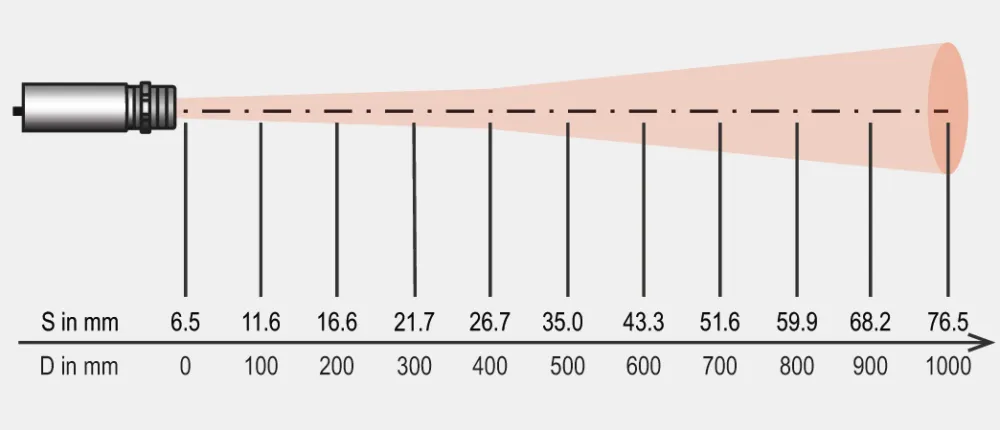
Recommended Products



Talk to us about your IR Temperature Measurement Requirements
Our Infrared Temperature Measurement experts can help you find the right Optris product for your application.
