


F-number
The F-number is a key parameter that describes an optics system. It is defined as the ratio of the focal length to the effective aperture diameter (or entrance pupil). Historically associated with photography, the F-number plays a crucial role in various optical properties, including depth of field, optical resolution, and the amount of light transmitted to the detector. In photography, the aperture is often variable, significantly affecting these characteristics.
A smaller aperture, which corresponds to a higher F-number, usually results in less light reaching the detector. This may require lower frame rates or produce higher noise. This relationship between aperture size and exposure time or frame rate is the reason why F-numbers are referred to as “slow” (higher F-number) or “fast” (lower F-number).
Multiplying the F-Number with [math]\sqrt{2}[/math] will lead to half of the aperture’s area, and the light transfer will be half of the initial amount. In the context of thermography, such as with pyrometers or thermal imaging cameras, the F-number has a significant influence on thermal resolution, as referred to in the relation NETD [math]\sim F^2[/math]. This highlights the impact of the F-number on both frame rate and thermal resolution in thermal imaging.
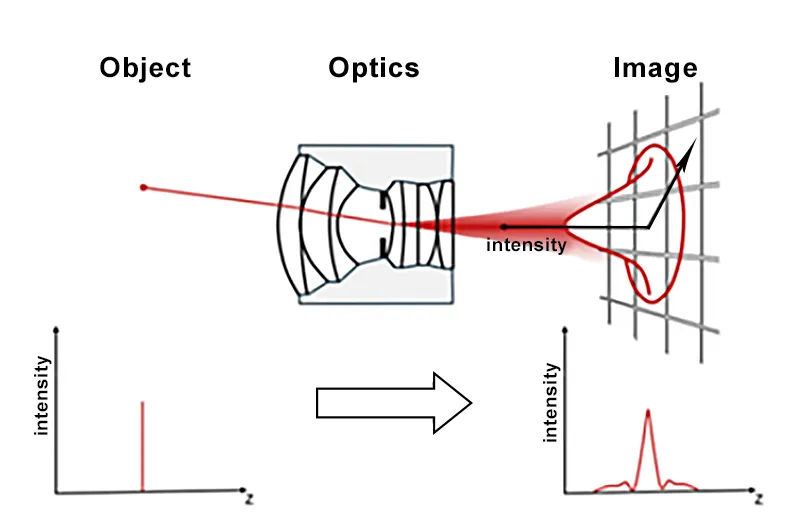
Particularly for long-wave infrared (LWIR) applications with small detector sizes, such as 12 µm pixels for uncooled focal plane arrays, a low F-number is essential for achieving competitive optical resolution and accurate temperature measurement even for small targets. In that case, the F-number is the most important value to describe the performance of infrared cameras. The aim is to create diffraction-limited optics that generate the best possible pattern on the detector, the so-called Airy disk. At a certain wavelength, a low F-value is the only way to reduce the spot pattern to a reasonable diameter.
However, it’s important to note that a low F-number can also lead to image blurring and the introduction of aberrations. For that reason, a low F-number enhances the optical resolution or D:S ratio only if the optics design and manufacturing quality of the lens system are sufficiently high.
Additionally, the F-number has an impact on the depth of field, which increases with lower F-numbers. This can complicate the accurate measurement of temperatures at varying distances, especially for small targets. Adjusting the focus could fix this issue but would require additional effort. It is advisable to consider the depth of field characteristics of a particular thermal imaging camera when assessing its suitability for specific tasks.
Back to Lexicon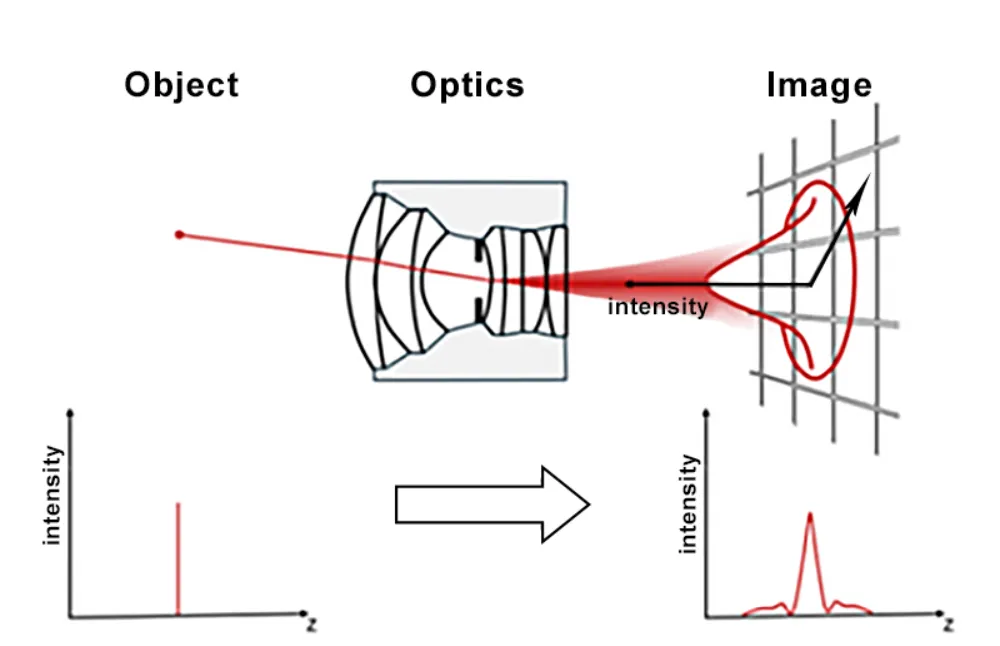
Recommended Products




Talk to us about your IR Temperature Measurement Requirements
Our Infrared Temperature Measurement experts can help you find the right Optris product for your application.
