


Filter
In the field of optics, a filter is an optical component used to either select or eliminate specific spectral properties of light. These filters are crucial for applications that require the transmission of a particular wavelength to a detector, while other wavelengths are rejected.
Optical filters are usually constructed on a substrate that allows significant transmission for the desired wavelength range. When a filter relies on the material’s properties to select light, it is known as an absorption filter. By adjusting the material’s thickness, the filter gradually alters the light to achieve the desired spectral characteristics and define a specific waveband.
In contrast, dielectric, thin-film, or interference filters function as reflecting filters. These filters do not absorb light; rather, they select light through reflection or transmission. They are composed of multiple thin layers of refractive dielectric material, typically applied to the substrate through vacuum deposition. Interference effects help favor the transmission of specific wavelengths. These filters must confine the waveband to the desired range while preventing atmospheric absorption, which can affect temperature measurement accuracy. As a result, bandpass filters are commonly used to determine cut-on and cut-off wavelengths, effectively limiting the light spectrum on both sides.
Before light reaches the detector, its emission spectrum is altered due to the transmittance of the optical elements and the spectral sensitivity of the detector. In temperature measurement, this process is primarily influenced by the Planck emission spectrum for blackbody radiation. Given the wide range of this spectrum, it is typical to choose a specific range that aligns with both the detector’s spectral response and an atmospheric window.
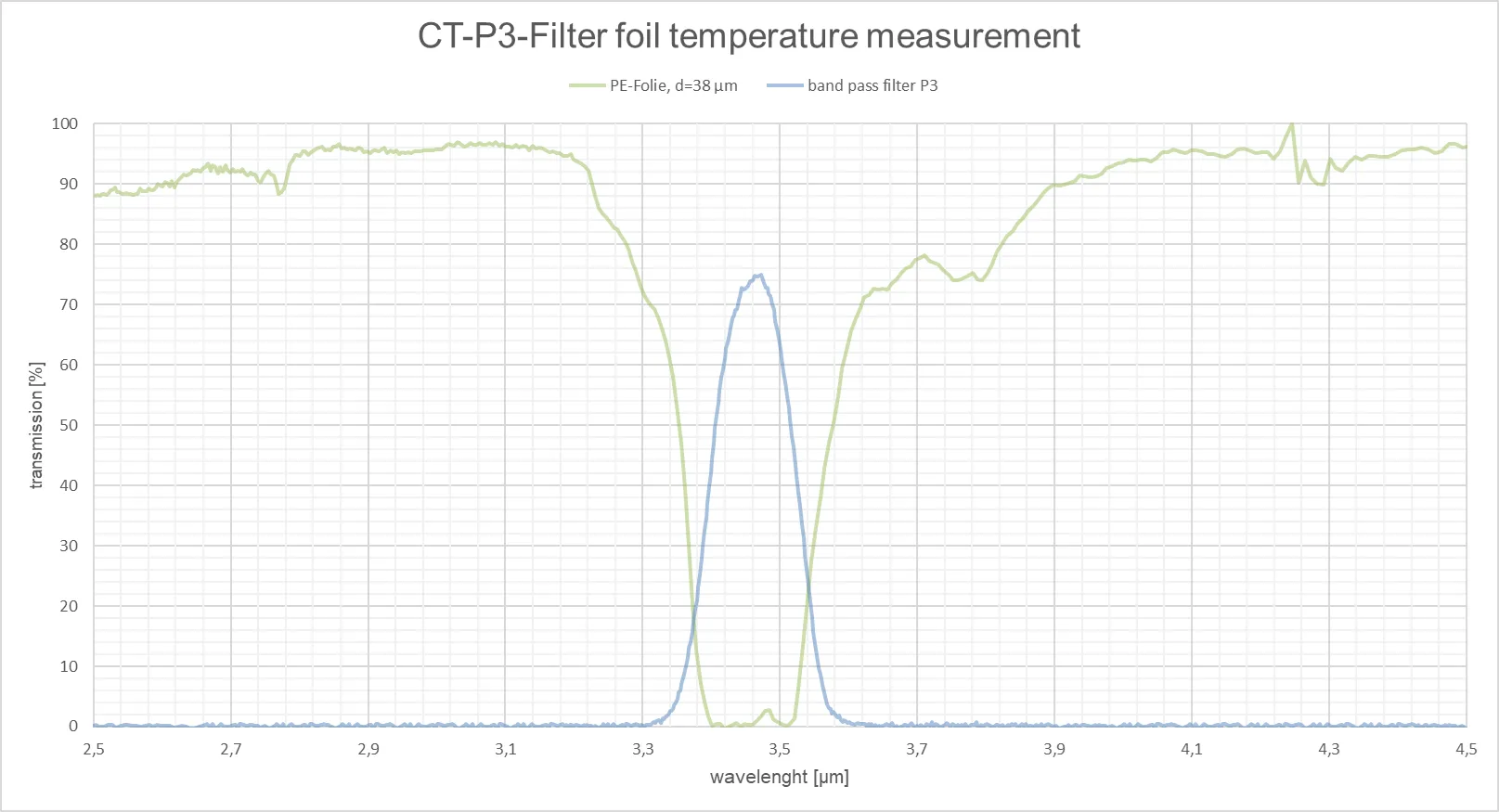
In practical applications, the material being measured often emits peaks rather than a continuous blackbody spectrum, with emission varying significantly with wavelength. A high emission level is often preferred, as it enhances the radiation for the measurement device. By understanding this, we can limit the waveband to the relevant spectrum. For instance, the P3 device measures the temperature of plastic materials at a specific wavelength. While using a standard wide band for measuring temperature in plastic foils can be misleading, measuring at 3.43 µm for Polyethylene is effective.visi
Back to Lexicon
Recommended Products




Talk to us about your IR Temperature Measurement Requirements
Our Infrared Temperature Measurement experts can help you find the right Optris product for your application.
