


Horizontal Field of View (HFOV)
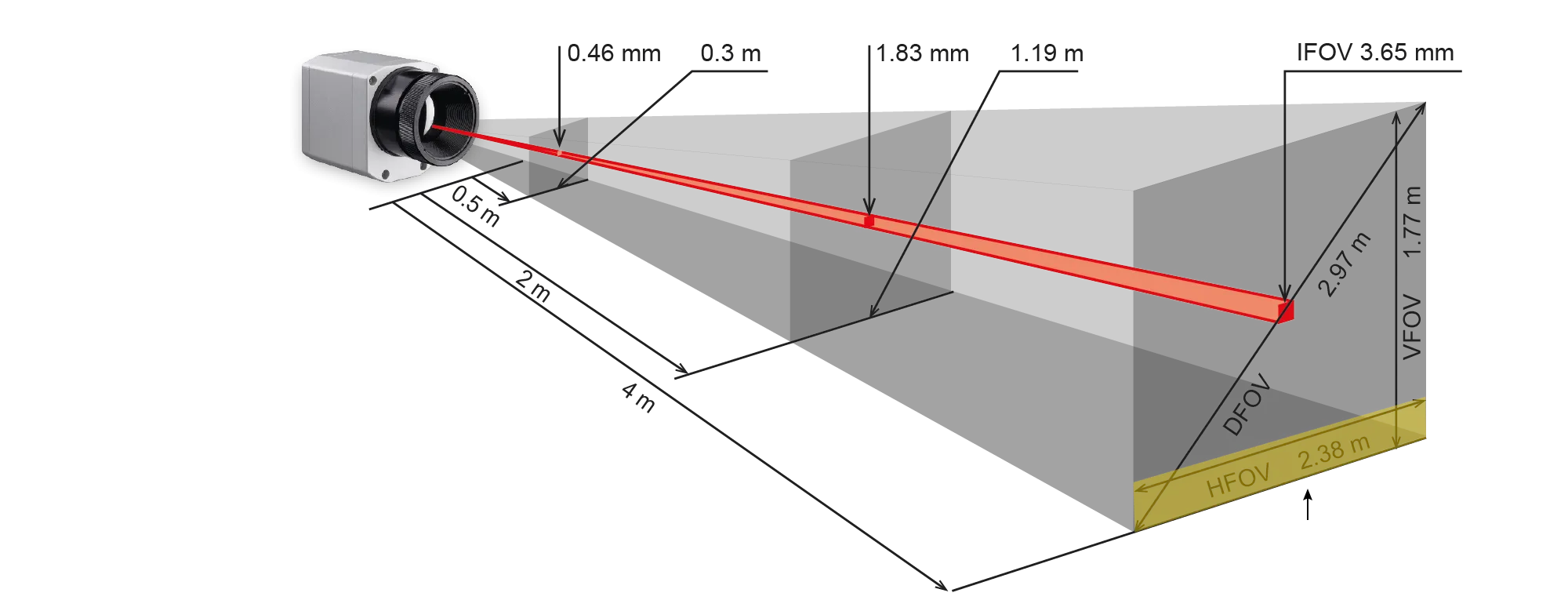
The horizontal field of view (HFOV) describes the width of the area of a scene that can be observed by the camera. A sensor in rectangular format is most commonly used, so the width of the sensor, together with the focal length of the lens, defines the HFOV. The horizontal and vertical image angles (width and height of the sensor) determine the total image angle of the camera. These two values result in the diagonal field of view (DFOV). In most cases, the larger side of the rectangular camera is aligned with the horizon, while the vertical FOV is oriented perpendicular to the earth’s surface.
In general, the field of view (FOV) of an instrument is described by the angle at which the device is sensitive and can detect the target object. For pyrometers, it is often defined as the measurement spot size of the thermometer. In thermography, the FOV of a camera determines the observable area of a scene that can be imaged by the camera. The camera FOV is typically expressed in degrees and depends on the configuration of optics and detector size of the thermal imaging camera. The FOV is defined by the ratio of the sensor size to the focal length ð‘“ of the camera optics.
Related to the sensor format, the FOV can be expressed as a horizontal field of view (HFOV) and a vertical field of view (VFOV).
In most cases, the object distance determines the choice of the FOV. For long-range applications, a narrow FOV (TeleOptics) can be selected, enabling the detection of small objects even at long distances. The use of a narrow FOV at a short distance is also possible. The short distance, combined with the narrow FOV, leads to a high magnification of the target. For advanced applications, microscope optics are required to detect small objects, even when using the 8 µm – 14 µm waveband.
With a wide FOV, the thermal imaging camera can capture a larger area, which is beneficial for general surveillance and rapid assessment of temperature distribution over wide areas. For example, when inspecting electrical installations such as control cabinets, a wide FOV enables the identification of electrical defects in confined spaces. Wide-angle optics can also be used for large-scale environmental monitoring, such as fire detection. To detect temperature anomalies, the thermographic image can be analyzed with a hotspot detection algorithm, which can generate inspection reports or directly trigger a process alarm.
Field of View and Optical Resolution
In addition to these FOV definitions, the spatial resolution, or instantaneous field of view (IFOV), must be considered to clarify the temperature measurement of small objects. The IFOV represents one pixel of the sensor array and determines the smallest resolvable object size. For accurate temperature measurements, the target size must be larger than the IFOV. Typically, the size of objects must be at least 3×3 pixels, defining the measurement field of view (MFOV).
Often, users are interested in a specific distance and want to know the FOV in millimeters or meters. An FOV calculator allows users to enter the camera/optics used and shows all necessary FOV data, such as HFOV, VFOV, IFOV, and MFOV.
The selection of the FOV in thermography cameras is closely linked to the camera’s optical resolution, which refers to its ability to distinguish small details. A camera with high optical resolution (or spatial resolution) can resolve finer details, which is critical when examining small or distant objects. This optical resolution is typically higher in cameras with narrower fields of view. Therefore, the trade-off between FOV and optical resolution is a key consideration in thermography, affecting both the quality and usability of the thermal imaging results.
Back to Lexicon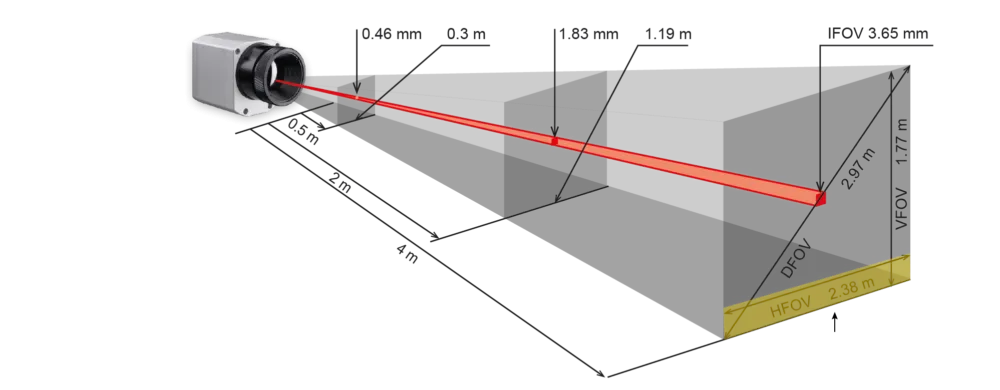
Recommended Products



Talk to us about your IR Temperature Measurement Requirements
Our Infrared Temperature Measurement experts can help you find the right Optris product for your application.
