


Instantaneous Field of View (IFOV)
The Instantaneous Field of View (IFOV) is the smallest target size detectable by an imaging system and represents one pixel of the sensor array, determining the smallest resolvable object size. It is usually associated with the horizontal FOV and can be calculated using the formula IFOV=HFOV/n, where n is the number of pixels in the horizontal FOV. The IFOV is an average value that can vary from the center to the edge of the FOV, especially for wide-angle optics.
It is a critical factor for spatial resolution and influences the temperature measurement of small objects. A smaller FOV corresponds to a smaller IFOV and higher optical resolution. It can be linked to the camera’s optics parameters by the equation IFOV [mrad] ≈ pixel size/f, where a smaller pixel size and larger focal length improve the IFOV.
Both sensor properties (pixel pitch) and optical parameters (focal length) affect the FOV. Theoretical calculations alone are insufficient; practical tests are necessary to ensure resolvability of objects within the IFOV. As sensor sizes become more compact, pixel sizes reduce, leading to more demanding image quality and necessitating improved optical performance.
For accurate temperature measurements, the target size must be larger than the IFOV due to the diffraction limit. Typically, a target size of 3×3 or 4×4 pixels is required to achieve 90% of the energy that defines the Minimum Field of View (MFOV). Smaller pixel sizes present challenges similar to those for the IFOV, and increasing the number of pixels in the array while keeping the sensor size constant is the recommended solution.
Users often seek the FOV in mm or m for specific distances and need to ensure that the object size is at least the MFOV. A FOV calculator can provide this and other necessary FOV data, such as HFOV, VFOV, IFOV, and MFOV.
The selection of the FOV in thermography cameras is closely related to the camera’s optical resolution, which determines its ability to distinguish small details. Cameras with higher optical resolution can resolve finer details, especially in narrower fields of view. Thus, balancing FOV and optical resolution is crucial in thermography, impacting the quality and usability of the thermal imaging results.
Back to Lexicon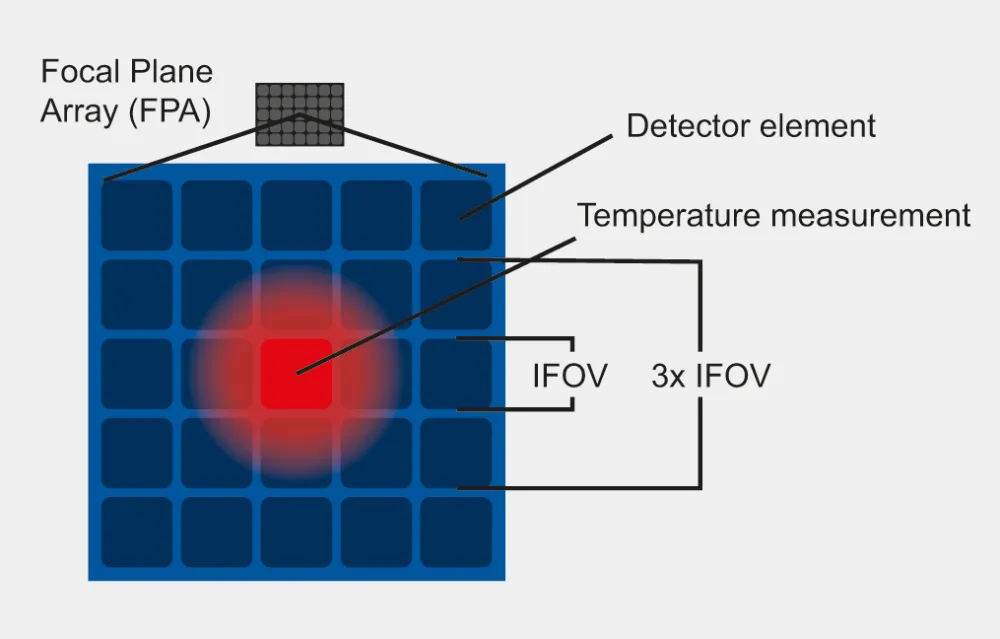
Recommended Products



Talk to us about your IR Temperature Measurement Requirements
Our Infrared Temperature Measurement experts can help you find the right Optris product for your application.
