


Measurement Field of View (MFOV)
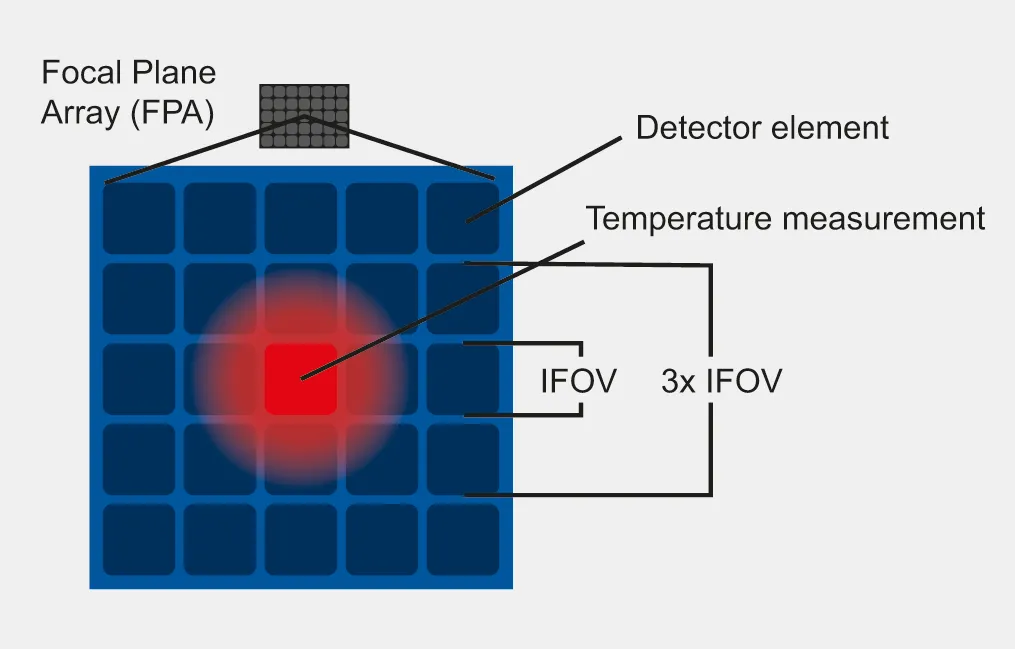
The measurement field of view (MFOV) defines the smallest target size required to obtain accurate temperature readings. It is usually defined for an object size of 3×3 or 4×4 pixels, where 90% of the target’s energy is obtained. The MFOV for thermal imaging is the equivalent of the measuring spot for pyrometer devices. Due to the pixel arrangement, it contains a discrete number of individual pixels so that it is linked to the instantaneous FOV.
Taking this into account we can define the relation
[math]MFOV=m\cdot IFOV[/math].
The value m represents the number of pixels m needed to reach the measurement spots size and the Instantaneous Field of View (IFOV) corresponds to one pixel of the sensor array and defines the smallest target size that can be detected by the imaging system.
For a more detailed understanding we can use the instantaneous FOV
[math]IFOV[mrad]\approx \frac{pixel size}{f} [/math]
and the link the MFOV to the optics parameter like focal length f of the imaging camera:
[math]MFOV [mrad]≈m \cdot \frac{pixel size}{f}[/math]
In that case, the IFOV and MFOV are a type of spatial resolution and must be taken into account to clarify the temperature measurement of small objects. While pixel size and focal length are well defined, the number of pixels m seems to be arbitrary. For a precise temperature measurement, it is just as large as the 90% of encircled energy value is reached. Because the 2nd zero of the Airy disk is containing 91% of the energy, we can define the airy diameter for temperature measurement as follows:
[math]d_{0,91}=4.5\cdotλ\cdot N[/math]
were λ is the applied wavelength and N is the F-number of the optics. This Airy disk diameter is nearly double compared to the standard definition (first zero of the Airy distribution) where only 84 % of the energy is contained.
The lower the F-number, the smaller the diameter of the spot that we can achieve on our sensor. In practical applications, the actual performance of the thermal imaging camera is important. While the Airy diameter sets the limit for the best case, the real performance of the optics can also limit the optical resolution of the infrared camera.
As the camera size and sensor size becomes more compact, the pixel size is gradually reduced. With a constant spot diameter, which is caused by the diffraction limit, the performance achieved for the IFOV decreases as the pixel size decreases. While the spot diameter (Airy disk) remains the same, the pixel shrinks more and more. In this case, smaller pixel sizes lead to a more demanding image quality and require improved optical performance.
Often the user is interested in a special distance and wants to know the FOV in mm or m and wants to make sure the object size is at least the MFOV. The FOV calculator enables to enter the used camera/optics and is showing all necessary FOV data like HFOV, VFOV, IFOV and MFOV.
The selection of the FOV in thermography cameras is closely linked to the camera’s optical resolution, which refers to its ability to distinguish small details. A camera with a high optical resolution (or spatial resolution) can resolve finer details, which is critical when examining small or distant objects. This optical resolution is typically higher in cameras with narrower fields of view. Therefore, the trade-off between FOV and optical resolution is a key consideration in thermography, affecting both the quality and usability of the thermal imaging results which are produced.
Back to Lexicon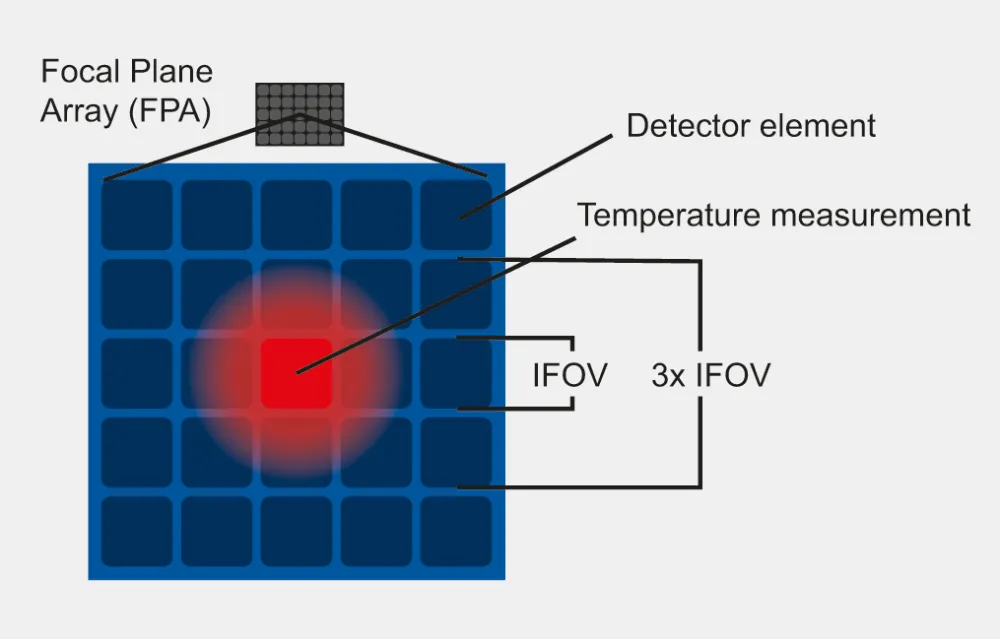
Recommended Products



Talk to us about your IR Temperature Measurement Requirements
Our Infrared Temperature Measurement experts can help you find the right Optris product for your application.
