


Modulation Transfer Function (MTF)
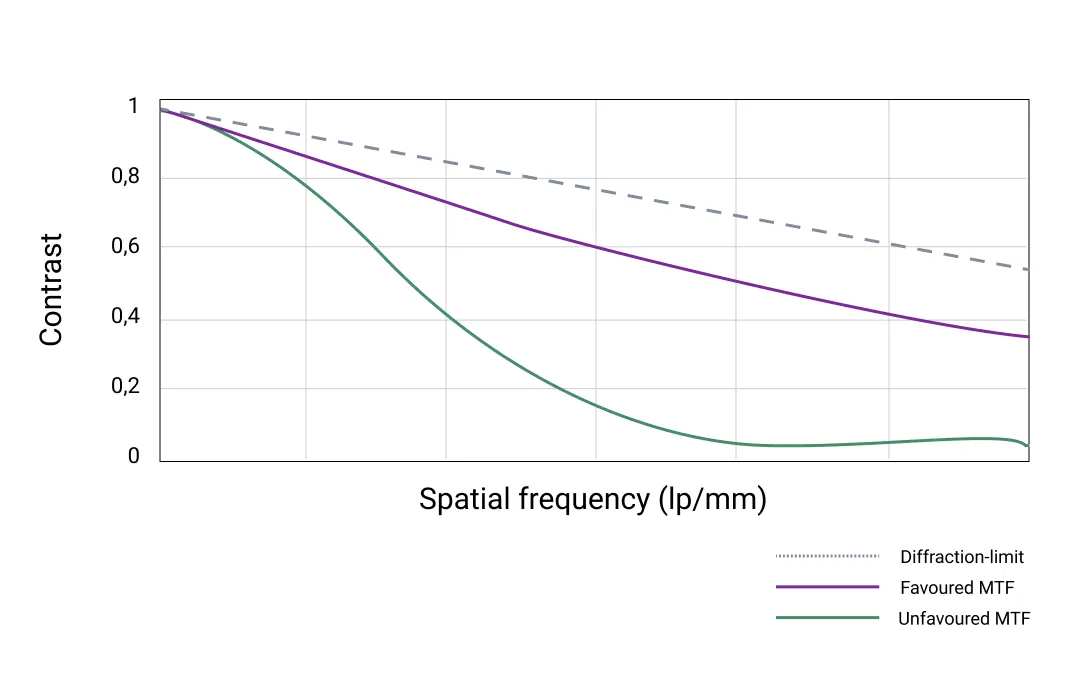
The Modulation Transfer Function (MTF) is a crucial metric used to characterize the performance of optical systems across various applications, from visual to long-wave infrared (LWIR) wavebands used in thermal imaging. MTF assesses how well a lens system can reproduce (transfer) detail from the object to the image, expressed as the contrast ratio of a sinusoidal pattern at different spatial frequencies. The resulting MTF curve shows the remaining contrast as a function of the spatial frequency. In this case, it is a method for describing the optical resolution and thus the measuring accuracy in the field of temperature measurement.
Factors affecting MTF include the wavelength of light used, the F-number of the optics, and lens aberrations—which may arise due to imperfections in lens manufacturing. It is important to differentiate between the MTF of the optical components alone and the system MTF, which combines the optics MTF with that of the detector. In thermal imaging cameras, system MTF is critical and heavily influenced by the detector’s pixel size, affecting overall image optical resolution.
Optically, diffraction at the aperture generates an Airy disk pattern, which represents the theoretical performance limit, solely determined by the wavelength and the F-number. This behavior can be seen as the diffraction limit and stands for the best case. In practice the optics will bend the radiation with its refracting power and aberrations will be introduced while focusing it on the sensor plane.
All together will lower the MTF value from the target reference to the MTF output on the detector array.
As the wavelength range of the thermography camera is set to LWIR waveband, a low F-number becomes increasingly important. It ensures a small measurement FOV (MFOV) and high contrast even for small targets. However, the F-number is also related to the reasonable thermal resolution. Enabling enhancing optical and thermal resolution (NETD) a low F-number is one of the most essential parameters for advanced thermal imaging.
MTF is quantified in terms of line pairs per millimeter (lp/mm), where a higher density of line pairs equates to higher spatial frequencies. The system’s ability to render details diminishes as it approaches a cutoff frequency. This frequency limit is driven by wavelength λ and F-Number N for the optics system and can be expressed by:
[math]f_{0,optics}=\frac{1}{\lambda\cdot N}[/math]
With large sensors, the contrast in the center of the image is usually optimal, while it decreases at the edges of the thermal image. For most imaging applications this may be acceptable, but for temperature measurement, it is most important that the MTF decrease remains moderate.
In addition to the influence of the optics, the camera detector also has a major effect on the MTF performance. The pixel size d determines the sampling rate of the target and defines the cut-off frequency, which is also known as the Nyquist frequency:
[math]f_{0,det}=\frac{1}{2\cdot d}[/math]
Exceeding this frequency can lead to aliasing, which may affect the thermal image information.
For accurate temperature measurements, especially when dealing with small isolated targets the target size must correspond with the Measurement Field of View (MFOV). This ensures that the optical resolution is sufficient for accurate temperature differentiation rather than just detection.
Back to Lexicon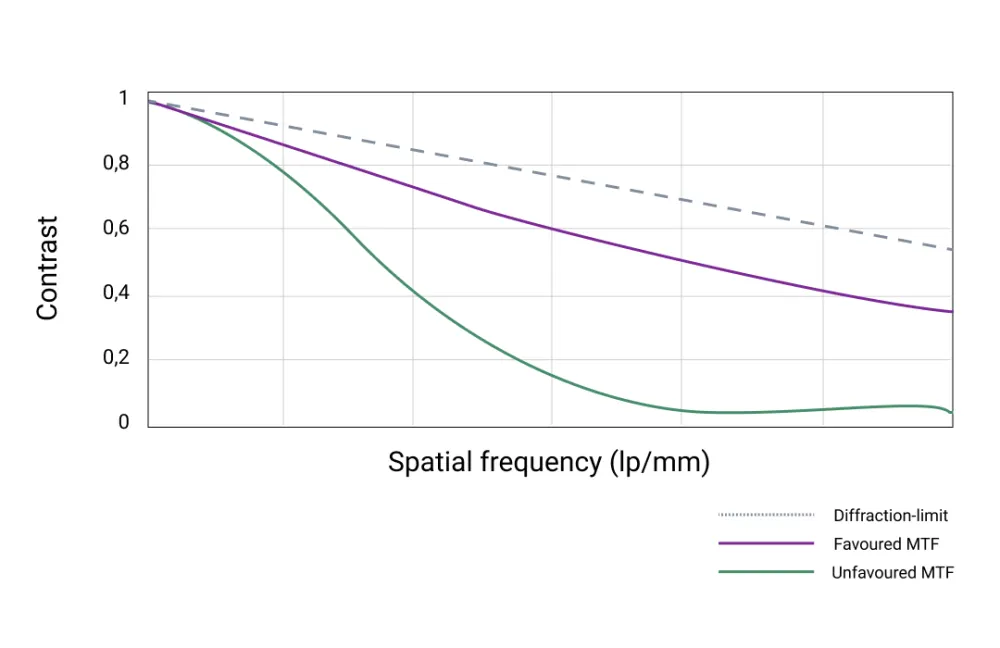
Recommended Products




Talk to us about your IR Temperature Measurement Requirements
Our Infrared Temperature Measurement experts can help you find the right Optris product for your application.
