


Non-Uniformity-Correction (NUC)
Non-uniformity correction (NUC) is a crucial process in the operation of infrared cameras. Its purpose is to alleviate the inherent non-uniformities in the captured thermal images. Infrared cameras, especially those using uncooled microbolometer sensors, often suffer from variations in response to thermal radiation at a pixel level. These variations can be caused by differences in detector sensitivity, electronic noise, and ambient environment. Without correction, these non-uniformities can significantly reduce the quality and accuracy of the thermal images, leading to incorrect temperature readings and poor image quality.
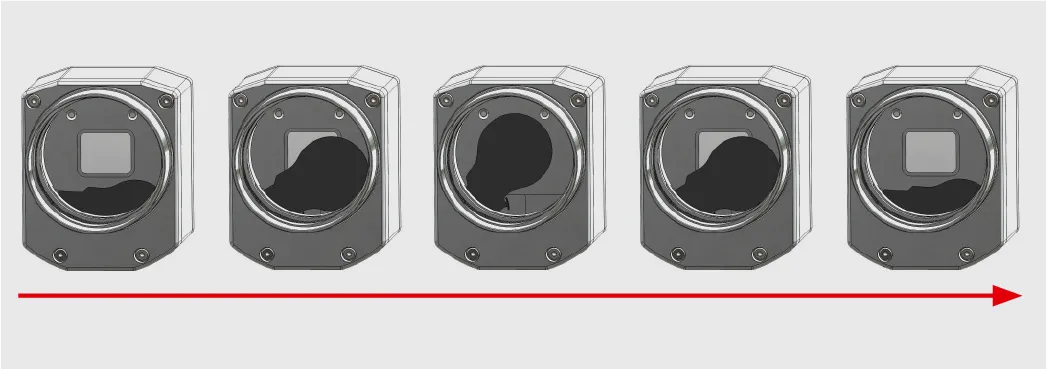
Non-uniformity correction (NUC) improves the accuracy of thermal images by measuring the internal infrared radiation from the camera’s optics and making adjustments to the image accordingly. In the process of performing a NUC, most infrared cameras temporarily block the IR optical path by positioning a shutter component with a flat, high-emissivity surface in place.
All thermal detectors generate a signal even when not exposed to thermal radiation, which is referred to as a “dark value”. For focal plane array detectors, each pixel has its dark value, also known as a “dark image” or “dark frame”. The dark value is an offset to the signal caused by the radiation from the target and must be subtracted to calculate the real signal. The dark frame of the detector depends on the temperature of the focal plane array, and for bolometers, this effect is particularly significant. A change in the bolometer chip temperature causes a much larger voltage difference at the output than the same change in the target temperature.
To determine the actual dark frame, an imager uses the flag, also called a “shutter flag”. The flag is a small plate that can be moved by an electrical drive into the optical path and is blackened on the side facing the detector to ensure it behaves like a black body. To reduce the overall size of the device, a flag could be made from lamellas.
When the flag covers the detector, the signals of all pixels are stored as the current valid dark frame. These values are then subtracted from any succeeding frame after the flag is reopened. Especially during the warm-up time, the chip temperature drifts, causing a significant drift in the calculated target temperature, which must be corrected by periodically cycling the flag.
Back to Lexicon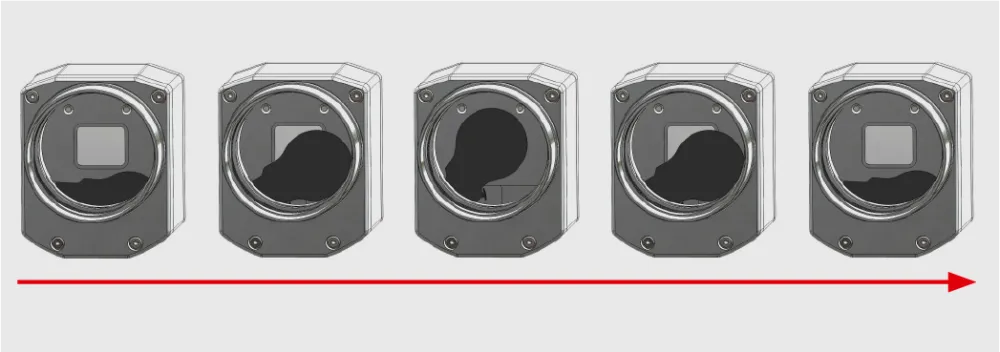
Recommended Products








Talk to us about your IR Temperature Measurement Requirements
Our Infrared Temperature Measurement experts can help you find the right Optris product for your application.
