


Optics
Optics encompasses the study of light generation, transport, interaction, and detection. When these principles are applied to engineering processes, the field is commonly referred to as photonics. Optical elements, such as lenses and mirrors, are crucial for directing and focusing radiation onto detectors. This process is integral to imaging systems used across various applications, including temperature measurement.
To control the trajectory of the light, optical elements are used to shape the radiation and focus it mainly on a detector. The imaging process is often carried out by a lens or a mirror system. For temperature measurement, the mirrors usually have a reflective metal coating. This coating is not strongly dependent on the waveband of the device and therefore does not cause dominant color aberration. Instruments with integrated reflective parts mainly suffer from complex off-axis designs or obstruction of light by secondary mirrors that reduce image contrast.
As an alternative to reflective elements, lenses can be used to shape the radiation. The beam passes through the optical element and is focused onto the image plane by refraction. As the light passes through each surface of the lens, unintended reflections occur, causing transmission losses. The lens material itself absorbs and scatters light, commonly introducing color aberration across all applied wavebands. To reduce color deviations, the most suitable material must be selected, combining materials with different dispersion properties to minimize the deviation. The more lenses are integrated, the more degrees of freedom are added to reduce aberration. While in the past spherical surfaces were used for the development of infrared optics, today it is common to integrate aspherical lens shapes for thermal imaging to reduce the size and weight of the optics and to promote the development of diffraction-limited optics. For the mid-wave infrared (MWIR) band, silicon is a commonly used crystal, whereas germanium is preferred for long-wave infrared (LWIR) applications. Advancements in technology have increasingly made infrared chalcogenide glasses popular for thermal imaging applications.
The optics consist of lenses or reflective elements and an aperture to control the propagation of radiation. The most important parameters of an optical system are focal length, F-number, and the waveband used. While the focal length is related to the camera’s field of view, the F-number is important for high optical resolution and therefore a high D:S ratio. The F-number (N) is also related to the NETD of the camera. A NETD is linked to an F-number of N=1, changing the F-number to N=2 increases the NETD by a factor of 4. In practice, a low F-number (large aperture) leads to more complex lens designs and a larger size compared to optics with higher F-numbers. For advanced temperature measurements, lower F-numbers are essential for thermal imaging applications. Due to the ever-decreasing pixel sizes of sensor manufacturers, good optical resolution can only be achieved with a competitive F-number and moderate optical aberration. Both together can lead to diffraction-limited systems for temperature measurement.
Back to Lexicon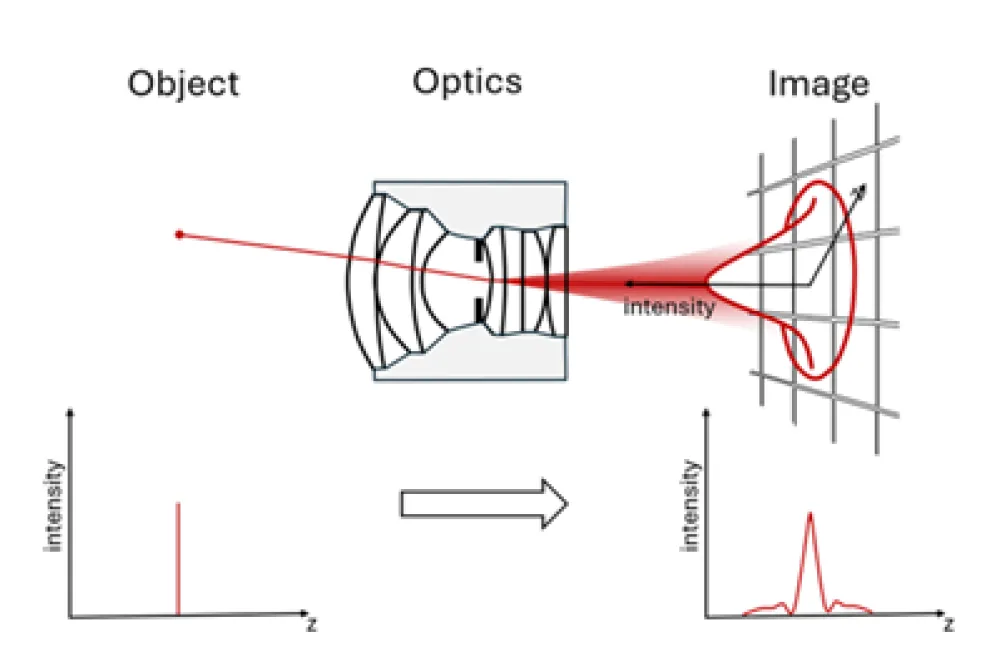
Recommended Products








Talk to us about your IR Temperature Measurement Requirements
Our Infrared Temperature Measurement experts can help you find the right Optris product for your application.
