


Pyrometer
A pyrometer is an instrument used to measure the temperature of an object without touching it. This is valuable in many industries where non-contact temperature measurement is necessary. Pyrometers are commonly used in metallurgy, glass production, semiconductor manufacturing, and mechanical systems monitoring.
Pyrometers work by detecting the infrared radiation emitted by an object. All objects with a temperature above absolute zero emit infrared radiation, which is a type of electromagnetic radiation that is invisible to the human eye but can be detected by infrared sensors.
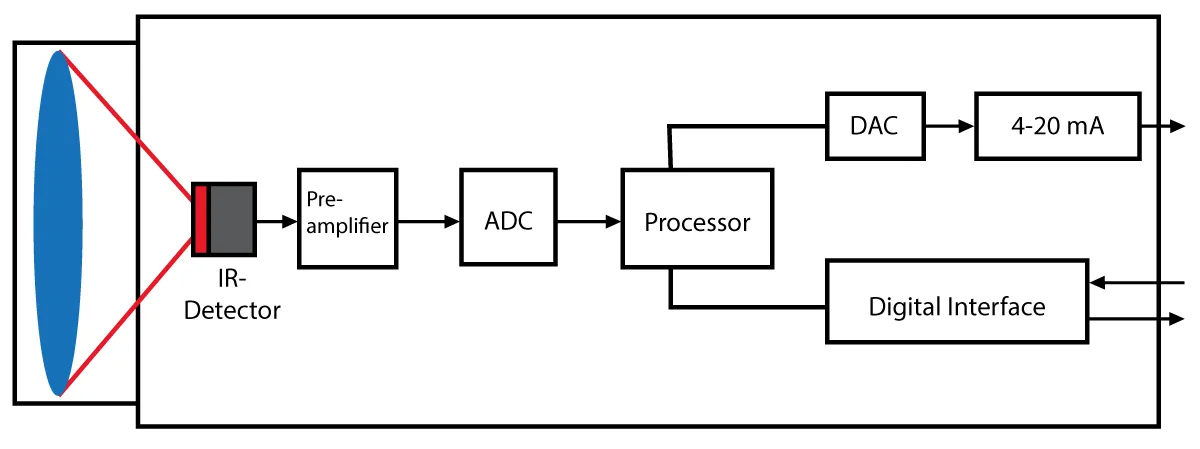
Pyrometers typically have three main components: an optical system, a detector, and electronics. When measuring the surface temperature of an object, the optical system captures the energy emitted by the object and focuses it on the detector, which is highly sensitive to the infrared bandwidth. The detector’s electrical signal depends on the temperature of the object, its ambient temperature, and its sensitivity. This weak electrical signal is then amplified and digitized by the pyrometer’s electronics. The digitized data is continuously corrected using calibration data, and then the temperature values are obtained, followed by further signal processing for analog or digital outputs, depending on the interfaces.
Pyrometers come in different models with varying spectral ranges, measurement ranges, speeds, sensitivities, and resolutions, catering to different budget levels. They also offer different performance class alignment options for various applications.
The most significant advantage of pyrometers is their ability to measure temperature from a distance, which is essential in environments where direct contact is not practical or safe. They provide fast and accurate readings and can monitor moving objects or surfaces without interference. However, their accuracy can be affected by factors such as emissivity variations, reflections, and environmental conditions. Proper calibration and understanding of material properties are necessary for reliable measurements.
Back to Lexicon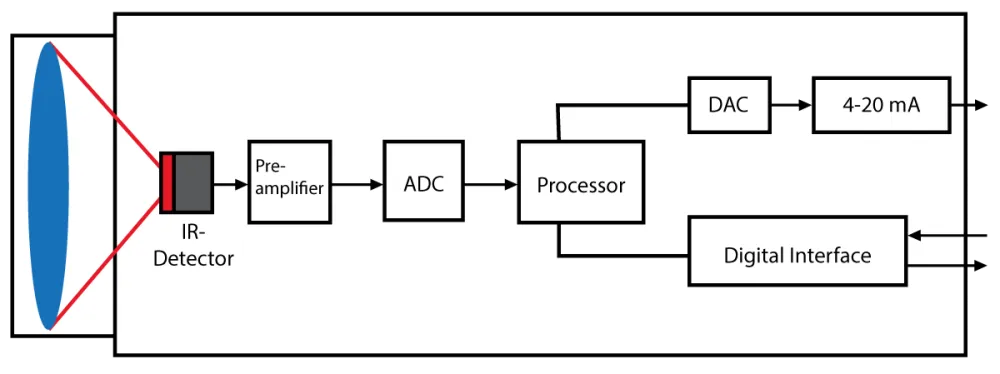

Talk to us about your IR Temperature Measurement Requirements
Our Infrared Temperature Measurement experts can help you find the right Optris product for your application.
