


Single Wavelength Measurement
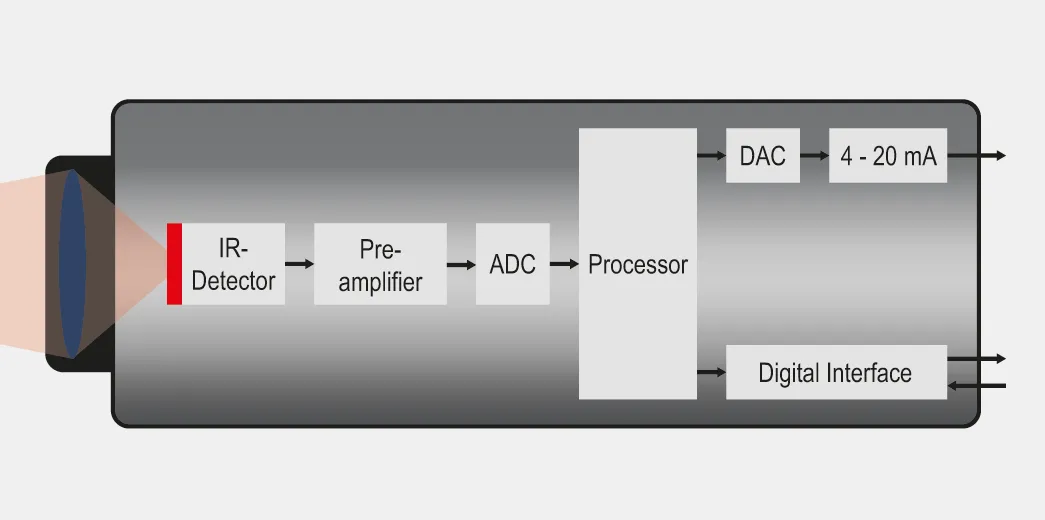
According to Planck’s radiation law, every body emits electromagnetic radiation. If this radiation is detected and evaluated correctly, the surface temperature of the body can be calculated. With single wavelength measurement, not all the thermal radiation emitted by a body is evaluated by a detector, but only radiation within a relatively small spectral range. The remaining radiation is discriminated by the use of spectral filters. Most commercial infrared thermometers (pyrometers and infrared cameras) use this concept.
Although this procedure reduces the signal strength and thus the sensitivity of the device, it is necessary in practice for various reasons. Firstly, the spectral response of detectors cannot be optimized for the entire electromagnetic spectrum. The available infrared detector materials (e.g., silicon for the range 0.4 µm to 1.1 µm, InGaAs for the range 1.3 µm to 2.6 µm, etc.) already specify certain spectral ranges for the use of infrared thermometers.
Secondly, various atmospheric gases influence the transmissivity of infrared radiation. To minimize the influence of these gases on the measurement result (an object temperature), it is preferable to use the areas of the infrared spectrum that are little influenced by these gases—the atmospheric windows.
Thirdly, the emissivity of the measurement object can be very small in certain spectral ranges and subject to strong changes during the process, while it is rather large and constant in another spectral range. In such a case, it is more advantageous to discriminate the more unstable signal range for a meaningful measurement.
An alternative is dual-wavelength measurement, where the signals of two detectors are evaluated, both sensitive to different spectral ranges.
Back to Lexicon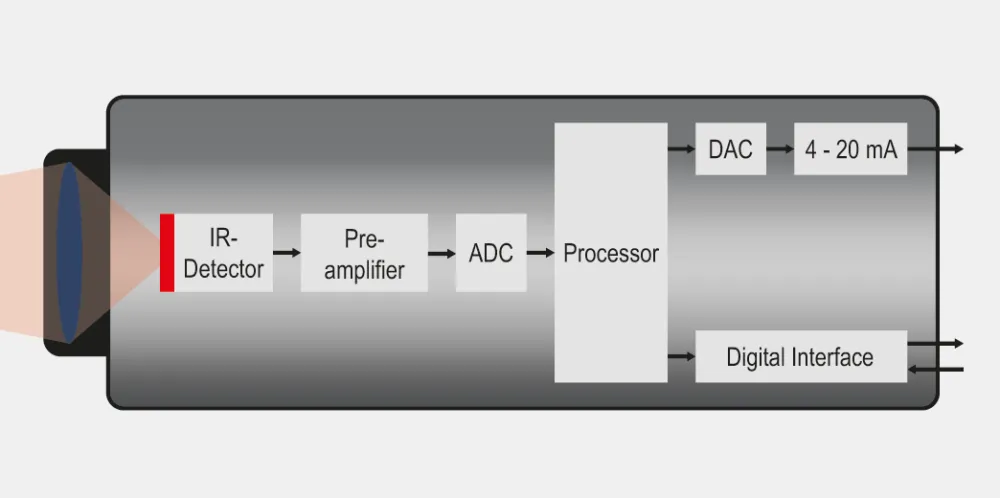
Recommended Products


Talk to us about your IR Temperature Measurement Requirements
Our Infrared Temperature Measurement experts can help you find the right Optris product for your application.
