


Target Size Effect
The Size of Source Effect (SSE), sometimes also known as the Target Size Effect, in the field of temperature measurement is an important phenomenon that describes an additional radiation influence on the device detector. It is a crucial factor for precision temperature measurement.
Both pyrometers and thermographic cameras are calibrated at a specific distance and with a specific radiation source diameter, which defines the calibration geometry. In practice, the target is usually not the same size as the calibration source. To quantify this, we can measure the SSE under laboratory conditions to obtain information about a real temperature measurement application. To do this, the measured temperature value is tracked while varying the size of the radiation source.
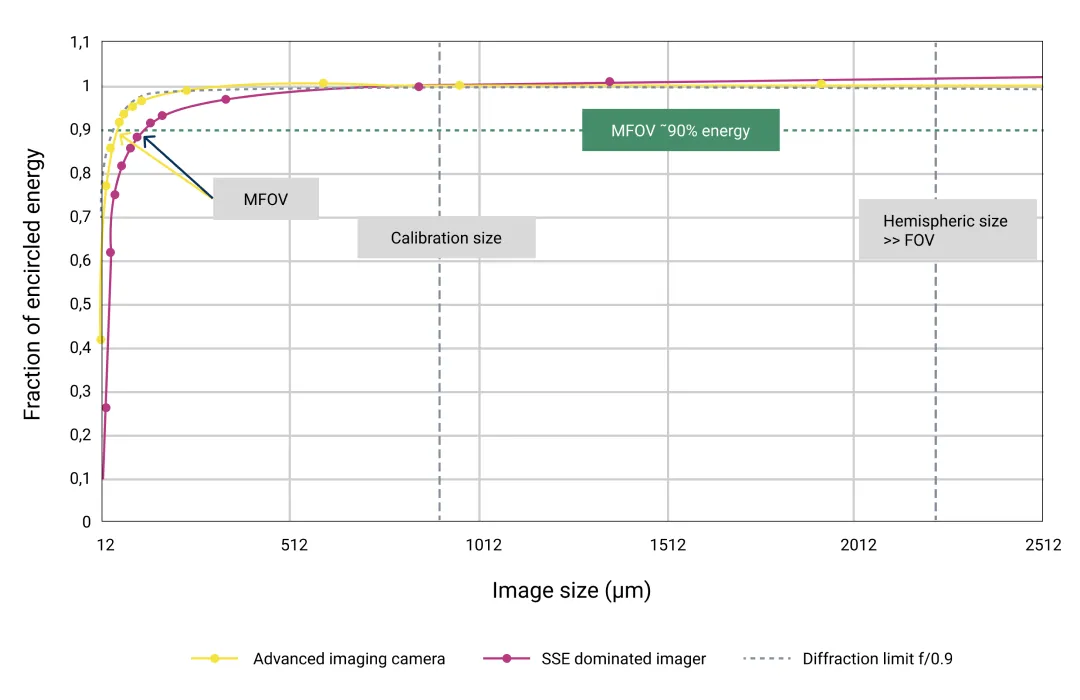
By definition, the radiator’s diameter is much larger than the measuring spot, typically achieved through moderate calibration distances. Increasing the radiation source’s size generally results in additional radiation, leading to a higher measured temperature. If the diameter of the radiator is doubled from 50 mm to 100 mm, for example, the surface area increases by a factor of four, which increases the radiation entering the measuring device and results in a higher temperature reading. The maximum temperature value corresponds to the radiation emitted by a hemispherical radiation source (half-space). For these larger radiation sources, the SSE is dominated by reflection and scattering effects within the optical system.
In contrast, a reduction in the source diameter due to the size of the calibration geometry leads to a reduction in the signal level on the detector. Consequently, the measurement spot for pyrometers is defined by 90% of the energy, which represents the minimum spot size diameter for accurate temperature measurement. For thermal imaging, the minimum spot size is described by the MFOV (Measurement Field of View), which typically represents 3×3 pixels. For small targets the size of the MFOV, the SSE is dominated by lens aberration and diffraction. The diffraction limit of the device depends purely on the wavelength and F-number, which is due to the physical diffraction limit rather than an imperfect optical system. In such cases, it is essential to consider the effects of increasing or decreasing the diameter of the radiation source, as a reduction often leads to a greater deviation in the temperature measurement.
Please note that the measuring distance is not changed. The only change was made by varying the size of the radiation source. In a real application, both changes can, of course, occur simultaneously and should be taken into account.
Back to Lexicon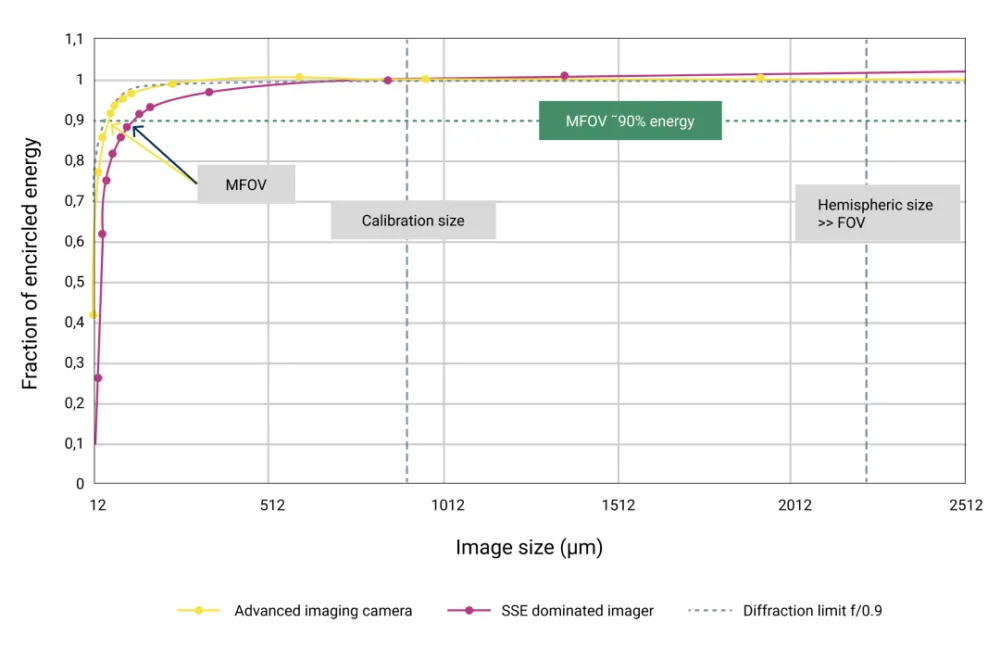
Recommended Products







Talk to us about your IR Temperature Measurement Requirements
Our Infrared Temperature Measurement experts can help you find the right Optris product for your application.
