

Automating Car Window Heater Defroster End of Line Test in Automotive Manufacturing
Leveraging Infrared Visioning and Temperature Measurement Technology to Improve Production Speed and Quality in Automotive Manufacturing
Challenge
Manual testing of car window defrosters is slow, inconsistent, and labor-intensive, taking up to 15 minutes per unit while posing a risk of overlooking fine defects in delicate heating wires.
Solution
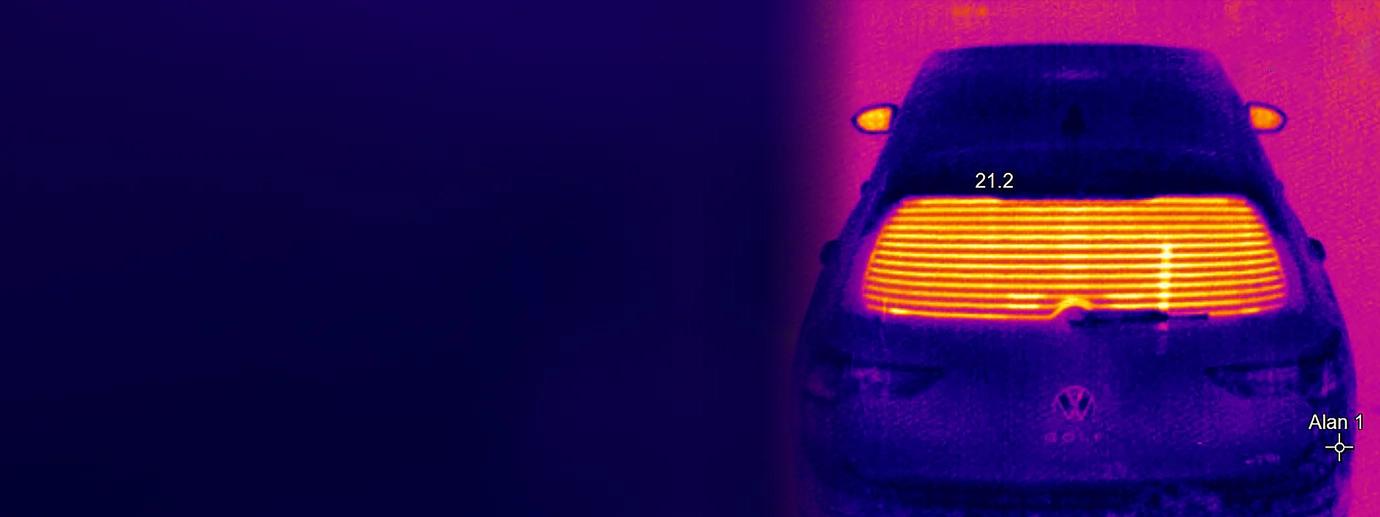
By simulating real-world conditions and continuously monitoring thermal behavior, automated thermal imaging enables accurate, fast evaluation of defroster function and durability in a production environment.
Benefits
- Reduces test duration from 15 minutes to just 30 seconds per window
- Allows staff to focus on other tasks by removing manual inspection steps
- Ensures uniform heating and detects broken or faulty wires instantly
- Enables automated pass/fail feedback through real-time thermal thresholds
- Improves reliability of the end product with consistent and repeatable testing
Time-consuming End of Line Tests for Functional Check of Car Window Defrosters
Window defrosters are a vital feature in vehicles, particularly in colder climates, where they help defrost ice to maintain driver visibility and safety.
The manufacturing process begins with producing window panes made from special laminated glass. Thin, nearly invisible heating wires made of electrically conductive material are integrated into these panes. These wires are strategically embedded in the glass to ensure even heat distribution and efficient heating performance. Acting as the rear windshield’s heat conductors, the defroster operates by sending an electrical current through a grid made of metal and resin, which is attached to the surface of the glass using an adhesive.
As the defroster resists the flow of electricity, it converts electrical energy into heat, warming the glass pane. Issues with the defroster are common because the wiring is typically small and fragile, making it susceptible to breakage.
The automotive manufacturer seeks an efficient solution to quickly and precisely measure the temperature of the windows, ensuring that the connections, installed cables, and wires work properly and have no defects before the vehicle’s final release.
Previously, this test procedure was performed manually by technicians, who would check by hand. This process of heating the elements took 10-15 minutes. The manufacturer aims to significantly speed up and automate this process as much as possible.


Automating Quality Tests with Thermal Imaging for Automotive Window Demisters
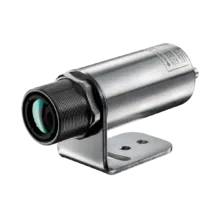
The solution for this application is the PI 640i thermal imaging camera from Optris. This compact VGA camera (640 x 480 pixels) with an outstanding thermal sensitivity of 40 mK detects and evaluates even the smallest temperature differences.
The PI 640i can be installed at any distance from the measurement object within the system, delivering necessary signals to any location (peripheral devices) and allowing operators to focus on other processes simultaneously.
During the final test, the electrical connection of the heating stripes is first examined by applying a defined voltage and measuring the current flow to ensure all wires function correctly without interruptions. Next, the defrosters are tested in a simulated environment to check their performance under real conditions. This involves deliberately misting the windows and activating the heaters to observe how quickly and evenly visibility is restored. Additionally, the window defrosters are tested for durability by repeatedly switching them on and off to ensure reliable performance after many cycles.
The PI 640i IR camera records every thermal change in real time and effortlessly monitors the entire process. If the temperature on the heated window surface exceeds or falls below a certain value (e.g., 35°C), the camera sends an analog signal to an alarm LED, which is easily visible to the specialist at the certification station in the automotive production facility.
Furthermore, the process can be fully automated, with follow-up actions (e.g., switching off the process) triggered by the Optris system. This automation shortens production time without disrupting the process flow.
Streamlining Automotive Production: Time-Saving Solutions with Infrared Temperature Visioning
The benefits of using Optris IR devices for the customer are clear: the measurement process has been reduced from up to 15 minutes to around 30 seconds, freeing employees for other tasks. These time savings and efficiency gains are major advantages, with cost savings justifying the use of the PI 640i.
The PI 640i offers significant advantages in many thermally-relevant production processes. Its high thermal sensitivity allows for quick detection of seat temperature changes, leading to increased time savings on the production line. Additionally, the PI 640i can capture radiometric video at frame rates of 32 Hz and even 125 Hz in subframe mode, enabling accurate monitoring and analysis of rapid temperature changes and dynamic processes.
The camera is equipped with interchangeable lenses that cover different fields of view (15°, 33°, 60°, and 90°), providing flexibility to adapt to various printer sizes and applications by allowing for the selection of the optimal focus and field of view.
The PI 640i is robust and designed for industrial environments, featuring an IP67 rating that protects against dust and water. It can operate in temperatures ranging from 0 °C to 50 °C, with separate accessories available to enhance its durability further. This ensures reliability and longevity even under demanding conditions.
Integration into existing systems is facilitated by various interfaces and a comprehensive software package. The camera can be connected via USB 2.0 or, optionally, via a Gigabit Ethernet (PoE) interface. The included Optris PIX Connect software package enables simple setup and remote monitoring of the camera.
Additionally, the camera offers several industrial process interfaces, including analog and digital inputs and outputs, as well as relays for alarm and fail-safe functions.

Recommended Products









Other Automotive Applications





Talk to us about your IR Temperature Measurement Requirements
There are over 300 different pyrometer variants to choose from in the Optris infrared pyrometer portfolio each optimized for material, spot size, distance from the target, and environmental conditions. Fortunately, there is a trained engineer to phone or chat with to guide you through the process of choosing the perfect infrared sensor for your application.
The same support is available for the extensive IR camera product line.
