

Automating the Flux Feeder during the Continuous Casting Process with IR
Prevent Breakthroughs and Damages in the Continuous Casting Process by Controlling the Flux Feeder with Infrared
Challenge
In continuous casting, fluctuating molten metal temperatures and incorrect flux amounts can lead to breakthroughs, damaging equipment, halting production, and risking worker safety.
Solution
By monitoring flux surface temperature in real time, the infrared camera enables automated flux feeder control, ensuring stable casting conditions and preventing critical temperature deviations.
Benefits
- Prevents costly production downtime caused by strand breakthroughs.
- Enhances worker safety by avoiding molten metal leakage incidents.
- Ensures consistent flux layer for optimal thermal insulation.
- Improves casting quality by stabilizing temperature across the mold.
- Enables reliable automation for more efficient process control.
Avoiding Breakthroughs: Mitigating the Biggest Risk in the Continuous Casting Process
Continuous casting is an essential process in the metal industry, particularly in the production of steel, aluminum, and copper. In this process, molten metal is continuously poured into a water-cooled mold to produce a solid strand, which can be further processed. These are called slaps.
A significant problem that can occur during continuous casting is the so-called breakthrough. Breakthrough occurs when the solid shell of the strand is not strong enough to withstand the pressure of the liquid metal inside and the shell cracks or perforates. This can be caused during the process by insufficient cooling or too fast casting speed. Temperature changes in the molten metal are the main reason that causes breakthroughs.
In case of a breakthrough molten metal escapes from the strand, which can cause considerable damage to the system and injuries to the staff which leads in any case to production downtime.
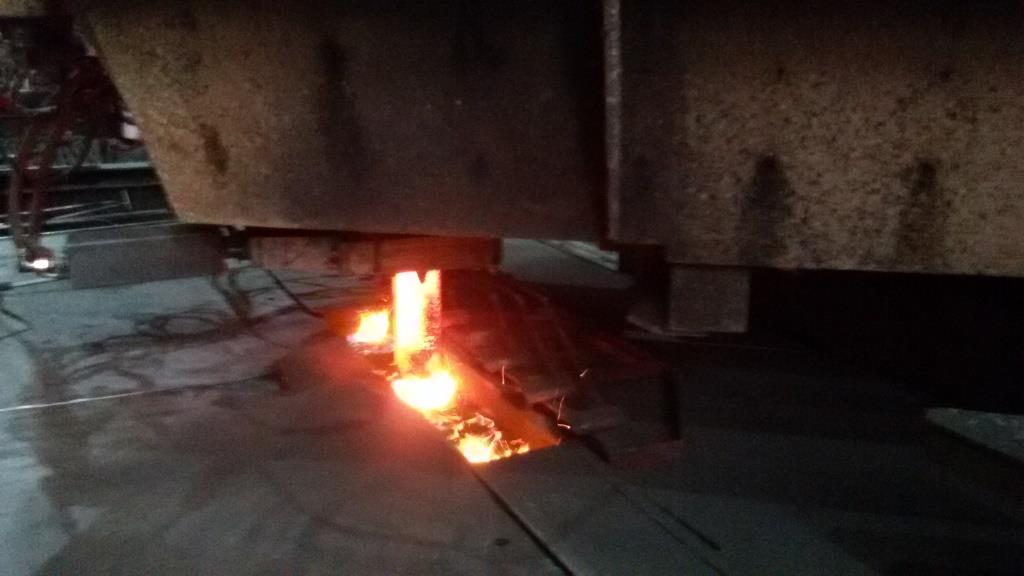
To prevent breakthroughs and to control and maintain a constant temperature, a so-called flux feeder is used. The flux feeder is designed to deliver a controlled and uniform amount of flux to the surface of the molten metal on top of the mold. As the molten metal gradually solidifies in the mold, the flux forms a layer of slag that floats on the surface of the molten metal, forming a protective layer on top of it. This insulates the molten metal which stabilizes temperatures and prevents breakthrough.
The flux feeder must be precisely controlled, as the wrong amount of flux causes problems. An insufficient supply of flux can lead to breakthrough or other defects, such as surface cracks, in the cast metal.
Controlling the Flux Feeder Process Using an Optris Infrared Camera
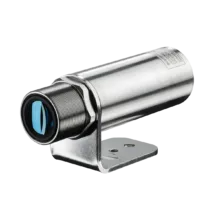
With the Optris Xi 410 thermal imaging camera, the supply of flux can now be automated enabling you to run the continuous casting machine without any problems.
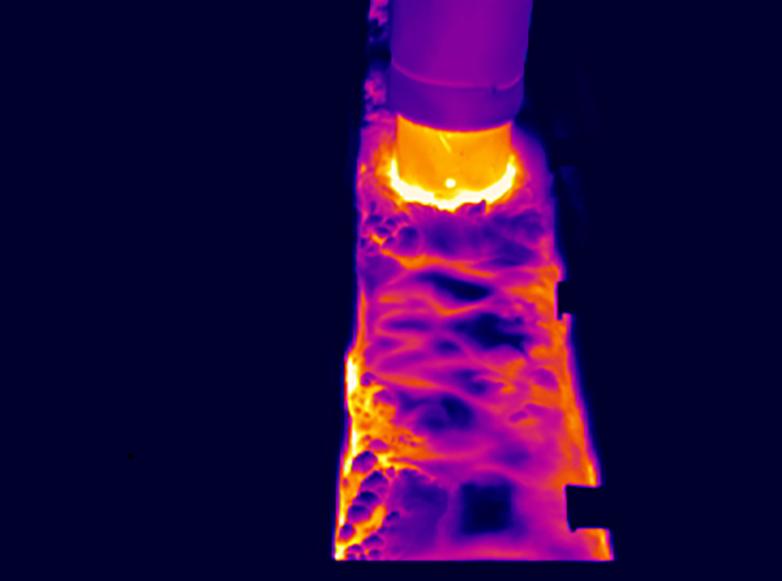
The IR thermal imaging camera from Optris monitors the temperature distribution on the surface of the molten metal in the mold. This monitoring provides real-time data on the temperature profiles and helps to identify critical areas that require special attention. In particular, the camera can determine whether the temperature is too high or too low in certain areas, which could indicate uneven flux distribution or other problems.
The camera is aimed at the spreading channel from above and measures the temperature of flux positioned on top of liquid metal passing through. Depending on the temperature detected, the signal is sent to the flux feeder, and the supply of flux is controlled to keep the temperature constant. Assuming that the insulation of the flux and the temperature of the molten metal are constant, the surface temperature of the flux is a good indicator of the thickness of the flux. Based on this temperature, the flux feeder can be automated for most homogeneous conditions in continuous casting plants.
Ideal for Metal Applications: Automating the Continuous Casting Process
The Xi 410 camera makes it easy to automate the flux feeder. As the IR camera is a stand-alone device, it transmits the temperature of the flux surface directly to the flux feeder or its PLC. The device can automated to apply the required amount and to keep the temperature of the molten metal constant under the flux.
Another advantage of the Xi 410 is the separately available accessories.
The robust, water-cooled housing allows the Xi infrared cameras to be used in hot and harsh environments up to 250 °C. Corresponding heat-resistant cables are available for all products.
The air purge for XI 410 protects the camera from deposits such as dust and particles on the lens as well as from smoke, haze, and high humidity (condensation), which can lead to incorrect measurements.
The autonomous operation with an automatic spot finder and direct analog or alarm output makes the Xi 410 for condition monitoring and OEM use.
With the optional industrial process interface the camera has up to 9 analog or alarm outputs, and the camera can be easily integrated into any process and any PLCs.
By using XI cameras you are supported by Optris PIX connect software, which offers extensive analysis functions and remote web server access.
The use of Xi cameras is rounded off with the Optris PIX Connect software, which offers extensive analysis functions and remote web server access.
Recommended Products









Other Metal Applications





Talk to us about your IR Temperature Measurement Requirements
There are over 300 different pyrometer variants to choose from in the Optris infrared pyrometer portfolio each optimized for material, spot size, distance from the target, and environmental conditions. Fortunately, there is a trained engineer to phone or chat with to guide you through the process of choosing the perfect infrared sensor for your application.
The same support is available for the extensive IR camera product line.
