

Enhance Steel Forging with Continuous Infrared Temperature Monitoring
Challenge
Maintaining precise temperature control during steel forging is essential, as overheating or insufficient heating leads to material defects, equipment damage, increased downtime, and maintenance costs. Traditional intermittent manual measurement methods struggle with rapid temperature fluctuations and accurate readings due to oxide scale, thus risking quality and efficiency.
Solution
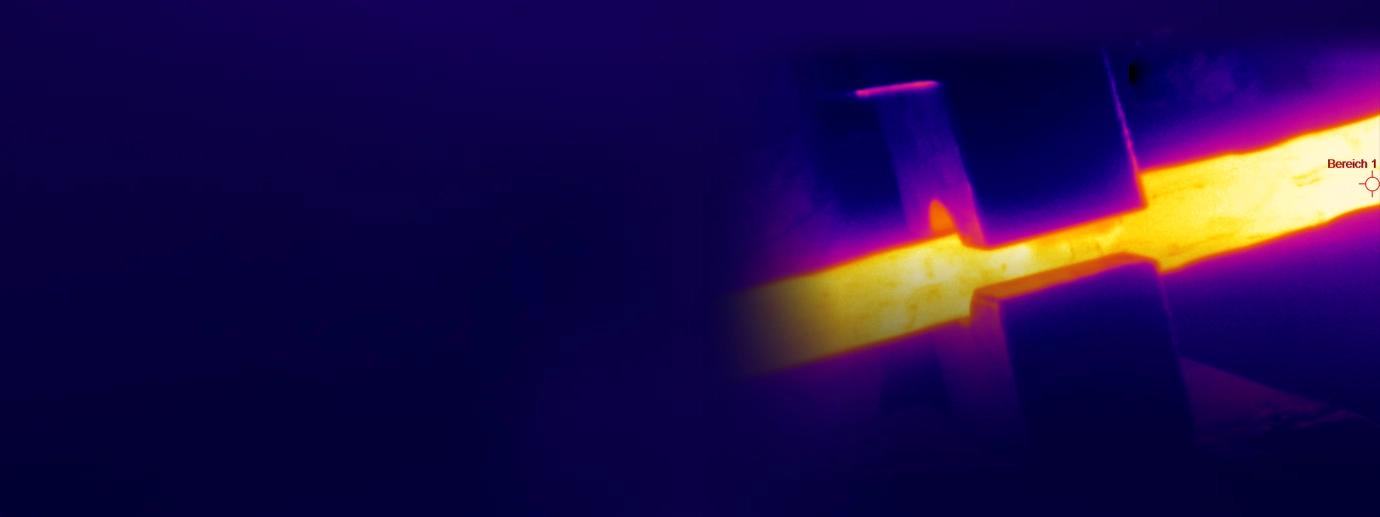
Infrared cameras continuously monitor steel temperature during forging, offering precise real-time thermal data. Positioned strategically, these systems enable immediate detection and correction of temperature deviations, ensuring uniform heating, optimal material properties, and minimal equipment stress, even in challenging environments with high heat, smoke, and dust exposure.
Benefits
- Reliable temperature monitoring ensures consistent steel quality, significantly reducing material defects and waste.
- Continuous real-time feedback allows quick response to temperature deviations, minimizing equipment damage and downtime.
- Automated thermal surveillance decreases manual intervention, lowering labor costs and human measurement errors.
- Documentation of thermal data throughout forging facilitates improved quality assurance and regulatory compliance.
- Precise temperature uniformity control prevents thermal gradients, eliminating product cracking and enhancing production efficiency.
Challenges in Steel Forging – Temperature Control as a Critical Factor
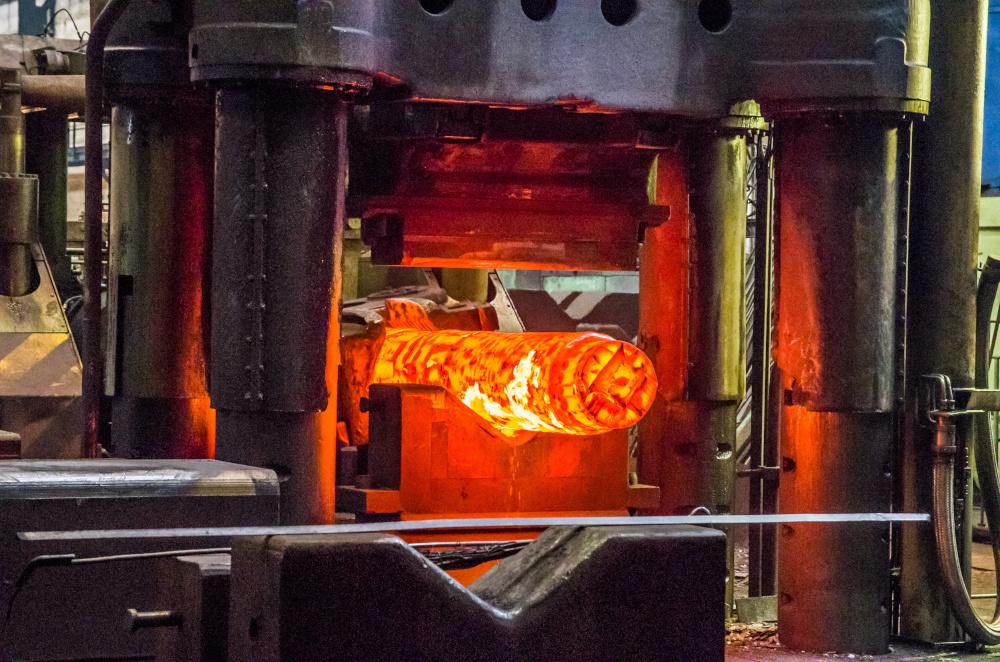
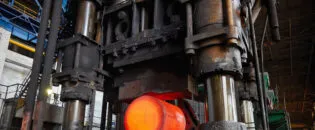
Steel forging is a complex process that involves deforming metal at high temperatures to achieve specific shapes and metallurgical properties. A critical step in this process is shaping the heated steel in a press, a common technique in hot forging. The process begins by heating the steel blank to a precise temperature, typically between 900 °C and 1200 °C. This high temperature alters the steel’s crystalline structure, making it plastically deformable. Monitoring the metal’s temperature relative to its recrystallization point is essential to ensure the correct metallurgical properties are obtained.
Maintaining this temperature range is crucial, as even slight deviations can lead to significant product defects. If the steel overheats, it risks burning, compromising material integrity and causing brittleness. Conversely, if it cools too much, the steel becomes harder to forge, increasing the risk of structural flaws. Additionally, improper temperature control can result in damage to processing equipment, such as dies, rollers, presses, or hammers, leading to expensive downtime and increased maintenance costs.
To mitigate these risks, accurate and continuous temperature measurement is essential. Traditional methods, such as handheld pyrometers, are often insufficient because they provide only intermittent readings and can miss critical temperature fluctuations. Additionally, manual operation can slow down the process.
The presence of scale (oxide layer) on the steel further complicates temperature readings, making the use of advanced monitoring solutions, such as infrared cameras, increasingly important. Infrared cameras provide real-time, precise measurements and, when integrated into feedback loops, help maintain optimal forging temperatures. This not only ensures the steel remains within the proper temperature range throughout the process but also reduces the risk of damage to equipment, minimizing downtime and maintenance costs while enhancing overall process efficiency.
Infrared Cameras for Continuous and Robust Temperature Monitoring in Steel Forging
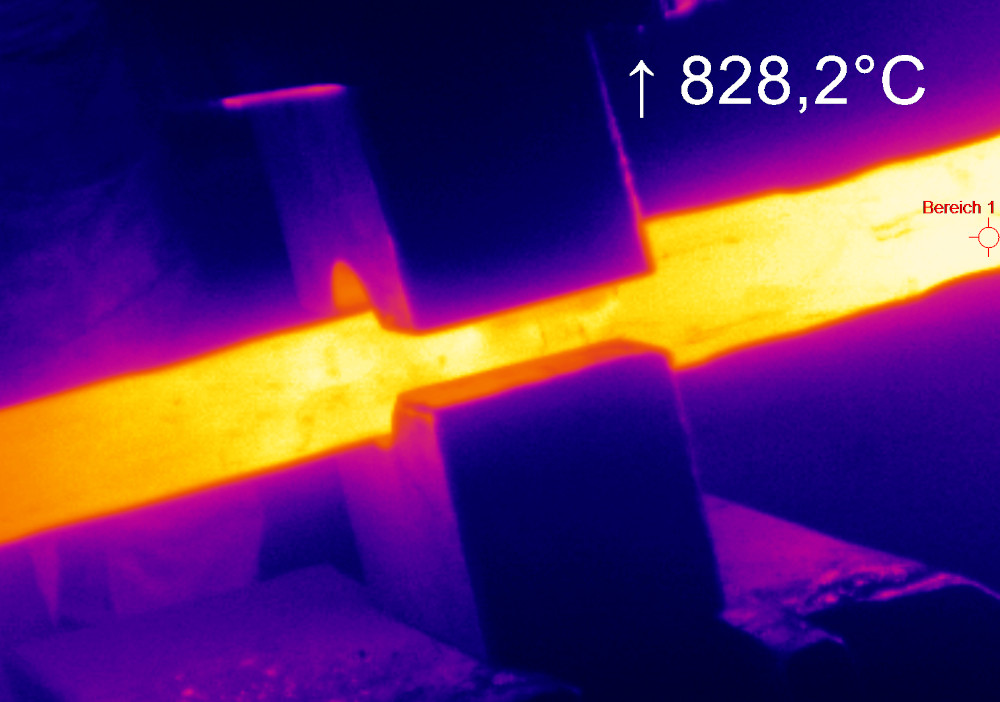
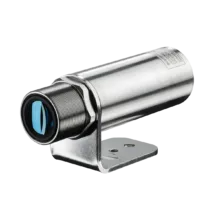
Optris infrared cameras, specifically the PI 1M model, are integrated into the steel forging process to provide continuous and accurate temperature monitoring. The camera is strategically positioned to have a clear view of the forging area, ensuring it captures the precise temperature of the steel as it undergoes deformation. The PI 1M features a highly dynamic CMOS detector with up to 764 x 480 pixels resolution, allowing it to capture detailed thermal images at a frame rate of up to 1 kHz, making it suitable for monitoring fast-moving processes. It is possible to monitor multiple production lines simultaneously with one IR camera, capturing and analyzing multiple temperature signals.
In scenarios with challenging environmental conditions, such as in open forging spaces with high levels of heat, smoke, and dust, the camera is housed in a protective cooling enclosure with air purge systems to maintain optimal functionality. The camera’s spectral range of 0.85 to 1.1µm is ideal for measuring the high temperatures encountered in steel forging without interference from reflections or environmental factors.
The system is connected to a PC running Optris PIX Connect software, allowing operators to monitor real-time temperature readings on a dedicated display. This setup provides and documents continuous data and ensures that any temperature deviation is immediately highlighted through a color-coded alert system, enabling operators to take prompt corrective actions. The infrared camera‘s hotspot detection feature further enhances measurement accuracy by focusing on the hottest part of the steel, ensuring the most critical areas are properly monitored. In addition, flexible measurement fields can be created in the PIX Connect software to monitor measurement areas of interest precisely, and the camera’s real-time analog output with a 1 ms response time ensures rapid feedback.
How Optris Infrared Cameras Enhance Steel Quality and Reduce Downtime in Forging Processes
The implementation of Optris infrared cameras has greatly enhanced the steel forging process by providing accurate temperature monitoring and eliminating the need for manual checks with handheld pyrometers. This continuous monitoring not only reduces labor costs but also minimizes the risk of errors associated with manual measurements. By ensuring precise temperature control throughout the forging process, the Optris system helps avoid under- or overheating of the metal, which can lead to equipment damage and costly servicing. The result is higher-quality steel with fewer defects, significantly improving customer satisfaction.
A key benefit of Optris devices is their ability to monitor product temperature uniformity, which minimizes thermal gradients and eliminates the risk of product cracking. This not only reduces waste but also boosts productivity by ensuring consistent quality throughout the production flow. The infrared cameras also identify overheated parts that need to be rejected, helping to maintain the integrity of the finished product.
Optris stands out as an effective solution for steel forging applications thanks to its flexible adaptation and seamless integration into various setups. With robust hardware, optimized accessories, user-friendly software, and dedicated customer support, Optris devices are designed to enhance performance. The Optris PI 1M infrared camera, with advanced features such as hotspot detection and real-time monitoring, offers unparalleled accuracy and reliability. Its cost-effective pricing, combined with specialized accessories like cooling enclosures and mounting brackets, makes it an attractive option for manufacturers seeking to optimize their forging processes.
Additionally, the system’s ability to document the entire forging process provides significant advantages in quality assurance and compliance with industry standards. By reducing costly process downtime, eliminating servicing costs, and maintaining product consistency, Optris pyrometers and infrared cameras are an ideal solution for metal and steel applications.
Recommended Products






Other Metal Applications





Talk to us about your IR Temperature Measurement Requirements
There are over 300 different pyrometer variants to choose from in the Optris infrared pyrometer portfolio each optimized for material, spot size, distance from the target, and environmental conditions. Fortunately, there is a trained engineer to phone or chat with to guide you through the process of choosing the perfect infrared sensor for your application.
The same support is available for the extensive IR camera product line.
