


High-Speed Thermal Monitoring for Improved Brake Disc Design
Thermal Imaging Enhances Brake Disc Testing on Test Benches for Improved Brake Disc Design
Challenge
Accurately analyzing the temperature distribution on metallic brake discs is difficult due to variable emissivity and the limitations of point-based, contact measurement methods during dynamic test bench simulations.
Solution
Knott GmbH uses thermal imaging to capture real-time temperature distribution across the brake disc surface, enabling comprehensive analysis under dynamic test conditions without interference or sensor wear.
Benefits
- Enables optimization of brake disc design through detailed thermal behavior analysis
- Identifies temperature hotspots that may lead to thermal stress or failure
- Supports real-time adjustments during testing to enhance safety and performance
- Reduces material usage and production costs through informed design decisions
- Prevents premature failures by ensuring effective heat dissipation strategies
Importance of Temperature Distribution Analysis of Brakes on the Test Bench
Understanding the thermal behavior of brake discs during testing is critical for optimizing their design and ensuring safety in automotive applications. The company Knott GmbH, known for producing brake systems for specialized vehicles such as trailers and forklifts, conducts extensive research and development on their brake discs. They use test benches to simulate real-world conditions, monitoring the temperature distribution across the brake disc surface. The goal is to understand how heat is generated and dissipated during braking events, as uneven temperature distribution can lead to thermal stress and potential failure.
The testing process involves mounting the brake disc on a test bench where it undergoes repeated braking cycles. These cycles simulate scenarios such as descending steep gradients, which generate significant heat. A major challenge in this process is accurately measuring the temperature across the disc’s surface, particularly given the disc’s metallic nature, which has variable emissivity. Traditional methods like thermocouples or contact-based sensors offer limited insights, as they can only measure temperatures at specific points, and are prone to wear and damage due to friction.
The motivation for employing advanced infrared temperature measurement techniques, such as thermal imaging cameras, stems from the need for non-contact, high-resolution data that provides a comprehensive view of the temperature distribution. This approach enables engineers to capture the thermal profile in real time, identifying hotspots and assessing the overall thermal behavior of the brake disc under test conditions.

High-Speed Thermal Imaging for Dynamic Testing
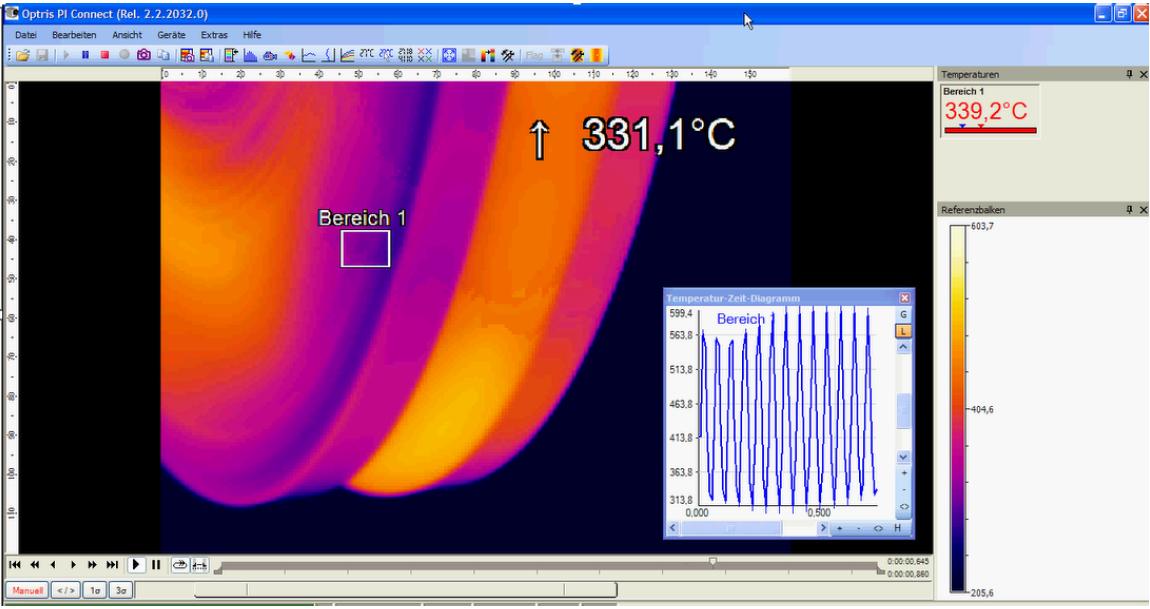
To address the challenges of accurate temperature measurement, Knott GmbH integrated the Optris PI 400 infrared camera into their test bench setup. The PI 400 offers a precise, non-contact method to measure temperatures ranging from 20°C to 400°C, making it ideal for monitoring the thermal behavior of brake discs. The camera’s ability to capture high-speed thermal images at up to 80 Hz allows for detailed analysis of temperature fluctuations during dynamic braking events.
The PI 400’s fixed installation on the test bench ensures consistent and repeatable measurements. Its compact design and USB connectivity make it easy to integrate into existing systems, providing real-time data directly to analysis software. This setup allows engineers to monitor the entire surface of the brake disc, overcoming the limitations of single-point measurement devices like pyrometers. The high frame rate of the PI 400 is particularly beneficial in capturing rapid temperature changes, essential for understanding the thermal shock experienced by brake discs during testing.
Optris’s infrared camera also deals effectively with the challenge of varying emissivity across the brake disc’s surface. Although the emissivity may not ideal, the rough surface finish allows thermal measurement with LT spectral range. The infrared camera delivers reliable data that engineers can trust.
Why Knott GmbH Trusts Optris for Cost-Effective Temperature Monitoring
The implementation of the Optris PI 400 infrared camera has provided Knott GmbH with significant advantages in their brake disc testing process. The high-resolution thermal images have enabled the identification of temperature distribution patterns that were previously undetectable with traditional measurement methods. This detailed thermal analysis has facilitated the optimization of brake disc designs, leading to enhanced performance and safety.
One of the key benefits observed by Knott GmbH is the ability to fine-tune the material composition and structure of brake discs based on precise thermal data. By understanding how different sections of the disc react under stress, engineers can make informed decisions to improve cooling strategies, reduce material usage, and ultimately lower production costs. Additionally, the real-time monitoring capability of the PI 400 allows for immediate adjustments during testing, preventing potential failures and ensuring that the brake systems meet the highest standards of safety.
Optris stands out as the preferred partner for thermal monitoring solutions due to its combination of high-performance infrared cameras, user-friendly software, and robust technical support. The PI 400’s unique selling points include its high-speed imaging, ease of integration, and ability to handle challenging environments, making it an indispensable tool for automotive testing and beyond.
Recommended Products









Other Automotive Applications









Talk to us about your IR Temperature Measurement Requirements
There are over 300 different pyrometer variants to choose from in the Optris infrared pyrometer portfolio each optimized for material, spot size, distance from the target, and environmental conditions. Fortunately, there is a trained engineer to phone or chat with to guide you through the process of choosing the perfect infrared sensor for your application.
The same support is available for the extensive IR camera product line.
