


Quality Check for Battery Pouch Cell Sealing
Detecting Faulty Seal Welding via Thermal Hotspot Detection during Load Tests with Infrared Imaging
Challenge
Ensuring reliable sealing in lithium-ion pouch cells is difficult, especially around connector flags, where undetected micro-leaks can compromise battery safety and performance during load tests.
Solution
High-resolution thermal imaging visualizes minute temperature differences, enabling automated detection of thermal anomalies from leaks without knowing their exact location in advance.
Benefits
- Detects micro-leaks early, reducing risk of defective cells in final products
- Enhances safety and longevity of pouch cells through better quality control
- Enables non-destructive, contactless inspection in real-time during manufacturing
- Integrates seamlessly into automated production for consistent, traceable results
- Reduces reliance on manual inspection, improving throughput and operational efficiency
Precise Welding for Optimal Performance in Lithium-Ion Pouch Cells
The welding of pouch cells is a crucial step in the manufacturing of lithium-ion batteries. Pouch cells, favored for their flexible and lightweight design, consist of multiple layers of electrodes and separators encased in flexible aluminum foil. The welding process ensures the cell’s hermetic sealing, which is essential for the battery’s safety and longevity.
Initially, the cell is placed in a specialized fixture that precisely aligns the foil layers. The open edges of the aluminum foil are then sealed using either heat welding or ultrasonic welding. The foil is heated to a specific temperature in heat welding, causing the materials to fuse. In ultrasonic welding, high-frequency sound waves agitate the molecules of the foil, creating a solid bond.
Controlling welding parameters such as temperature, pressure, and time is crucial to ensure a uniform and reliable seal. Inadequate welding can lead to leaks, potentially damaging the battery or impairing performance.
After welding, each cell undergoes leak testing, often using vacuum tests or helium leak detection. These quality assurance measures ensure that no air or moisture can enter the cell, which would compromise its chemical stability and lifespan. Overall, the precise welding of pouch cells is vital to ensuring the quality and safety of modern lithium-ion batteries.
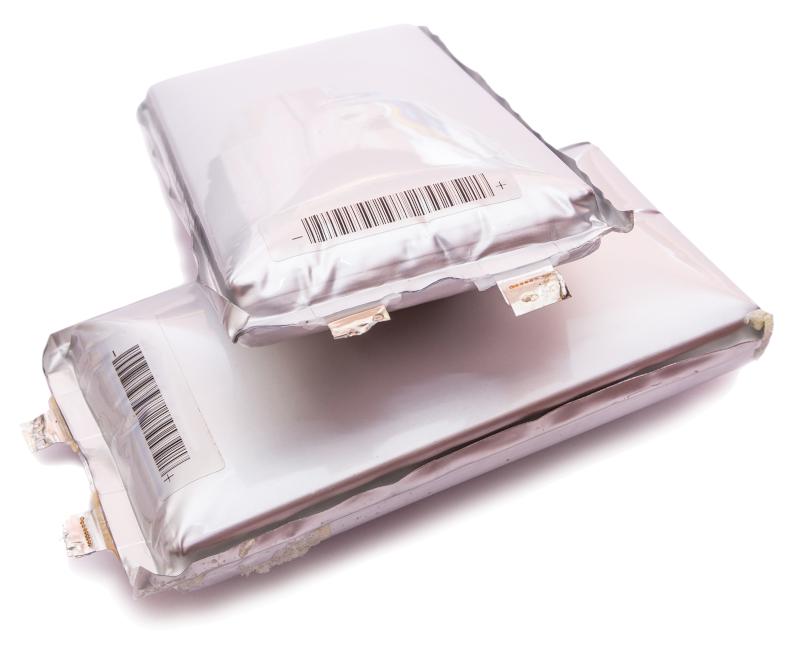
The most critical area of sealing a single pouch cell is around the connectors, also known as flags. Sealing the flags is challenging due to their geometric shape. The manufacturer of such battery cells needs a quality assurance test to verify that the welding of the cells is without issues.

Detecting Tiny Leaks in Battery Pouch Cells with High-Resolution Infrared Imaging
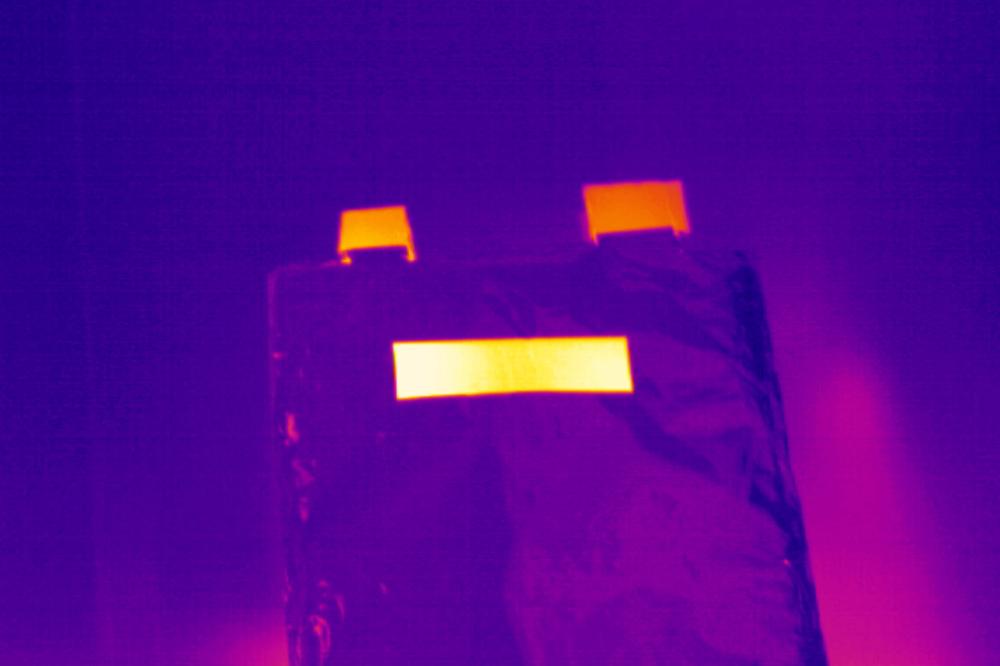
The edge of the flag passes through the foil, and if the sealing is weak at this point, it will lead to a temperature rise at the leakage point during load tests. A single-point pyrometer can only target the area if the exact location of a potential leak is known. However, an infrared image can highlight hotspots, making detecting leaks of unknown location and size much easier.
These leaks can be tiny, requiring the infrared image to visualize minimal areas. Additionally, the temperature difference might be small if there is a small leakage. Therefore, the thermal image must have high optical and good temperature resolution. The aluminum surface presents a challenge for an 8 µm -14 µm camera, but fortunately, the flags are partially coated in the critical area, increasing emissivity and aiding detection.
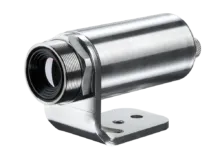
The Optris PI 640i infrared camera features a high optical resolution of 640 x 480 pixels, enabling the detection of leakages as small as 1mm using the standard lens. This camera primarily detects leakages to ensure the quality of battery pouch cells. The software can define the temperature difference as a criterion for a good cell, triggering an alarm as soon as an improper temperature deviation is detected. This alarm is forwarded to the control units, allowing each battery cell to be documented with an OK or NOK signature from the IR imager. Battery pouch cells showing a thermal difference indicative of leakage are subsequently scrapped. Quality assurance is now part of the automated manufacturing process.
Small MFOV, VGA Resolution, and low NETD are Key to Find Faults
For battery pouch cell manufacturing, the VGA resolution and low NETD (Noise Equivalent Temperature Difference) of 40 mK are crucial for detecting leakages. The VGA resolution, which provides a high optical clarity of 640×480 pixels, allows for detailed visualization of the cell surface. This high resolution is essential for identifying small defects that could lead to significant issues if left undetected. The clarity provided by VGA resolution ensures that even the tiniest irregularities are visible, facilitating precise quality control.
The low NETD of 40 mK enhances the thermal sensitivity of the infrared camera. This sensitivity is vital for detecting minimal temperature differences that indicate potential leakages. A low NETD means that the camera can discern very slight temperature variations, which is essential when identifying small leaks where the temperature difference might be minimal. This capability ensures that no defect goes unnoticed, maintaining the integrity and safety of the battery cells.
The MFOV is critical in applications involving battery pouch cells, where detecting tiny leakages requires high-resolution imaging. Coupled with a low NETD, MFOV ensures the thermal camera can discern small temperature differences, highlighting potential issues. This spatial resolution is vital for accurate temperature measurement and quality control, making MFOV a key factor in effective thermal imaging. The measurement field of view (MFOV) is essential for accurately determining the smallest target size needed for precise temperature readings. In thermal imaging, MFOV is akin to the measuring spot in pyrometer devices, defined by a specific number of pixels, ensuring 90% of the target’s energy is captured.
Recommended Products









Other Battery Monitoring Applications


Talk to us about your IR Temperature Measurement Requirements
There are over 300 different pyrometer variants to choose from in the Optris infrared pyrometer portfolio each optimized for material, spot size, distance from the target, and environmental conditions. Fortunately, there is a trained engineer to phone or chat with to guide you through the process of choosing the perfect infrared sensor for your application.
The same support is available for the extensive IR camera product line.
