


Optimizing Safety Glass Production with Advanced Infrared Sensors
Accurate Line Scanning Infrared Technology Improves Glass Manufacturing
Challenge
Accurately measuring temperature in laminated safety glass production is difficult due to glass’s low infrared emissivity, reflective coatings, and restricted access in lamination equipment. These issues hinder precise thermal control, risking uneven heating, poor adhesion of the PVB film, and defective products.
Solution
By using infrared sensors capable of accurate surface temperature measurement through narrow viewing slots, the lamination process is precisely monitored and controlled. Line-scanning infrared cameras and compact pyrometers ensure real-time thermal feedback even with coated or low-emissivity glass and limited sensor placement options.
Benefits
- Enables uniform heating, ensuring strong and consistent PVB bonding between glass layers
- Minimizes product defects by identifying temperature deviations in real time
- Reduces material waste and rework through early detection of lamination issues
- Improves process efficiency by enabling quick, data-driven adjustments during production
- Allows precise monitoring even in tight or obstructed equipment spaces
The Importance of Infrared Measurement in Safety Glass Production
In the production process of laminated safety glass, two to three glass panes are typically bonded together using a polyvinyl butyral (PVB) film under heat and pressure. The goal of this process is to create a layer that ensures the shards stick together in the event of glass breakage, preventing injuries. This process is often carried out in autoclaves or under vacuum using heating systems to achieve the necessary temperature and pressure, ensuring a stable bond within the laminate.
However, the production of laminated glass presents several challenges. One major issue is that glass is naturally designed to transmit as little infrared radiation as possible. While this is beneficial for preventing the heating effects of sunlight, it poses a significant challenge regarding temperature measurement during the lamination process. Since the film between the glass panes cannot be measured directly, the surface temperature of the glass must be used as an indicator of the temperature inside the laminate. Furthermore, depending on the type of glass used, the lamination process is typically carried out at relatively low temperatures, around 40 to 60 degrees Celsius. These lower temperatures are difficult to measure accurately with conventional temperature sensors.
Another complication arises when coated glass is used. Certain types of glass, especially those used in facades or vehicle applications, have special coatings that reflect infrared radiation to prevent sunlight heating. These coatings, however, make accurate temperature measurement even more difficult, as the glass’s emissivity is significantly reduced. Inaccurate measurements can result in the required temperature for proper lamination not being reached, which compromises the PVB film’s adhesion, leading to defective products.
In addition to these material-based challenges, there are also practical problems, such as limited access to the glass units during lamination. Often, the pressing units or laminating ovens are designed with only small viewing slots through which temperature measurements can be made. These restricted visual access points make it difficult to monitor the entire laminate precisely, leading to uneven temperature distributions and, consequently, flawed lamination.
Accurate temperature measurement is crucial for manufacturers, as they must ensure the glass surface is heated evenly to achieve a homogeneous bond between the glass panes and the PVB film.


Optimizing Laminated Glass Production with Line-Scanning Capabilities
In the laminated safety glass production process, precise temperature control is critical to ensuring proper bonding of the glass layers. Optris infrared cameras and pyrometers provide advanced solutions for monitoring and optimizing this process, particularly with models like the PI 640i, Xi 400, Xi 410, and the CT LT pyrometer. Due to glass’s low emissivity and reflective nature, infrared technology tailored to specific wavelengths becomes necessary. Infrared cameras with a spectral range of 7 to 9 micrometers are particularly suited for this task, as they can accurately measure the glass surface temperature. Despite the material’s limitations.
The Optris PI 640i is a high-resolution infrared camera that excels in detailed temperature monitoring. Its 640 x 480 pixel resolution allows manufacturers to capture precise thermal images of the entire glass surface, ensuring consistent temperature distribution across the laminate. This is particularly important in large production environments where uniform heating is crucial to avoid defects in the final product. The PI 640i can be integrated into the production line to continuously monitor real-time temperatures, allowing immediate adjustments to maintain optimal process conditions. This high level of thermal accuracy reduces the risk of production errors, ensuring a consistently high-quality output.
The Xi 400 and Xi 410 infrared cameras are compact and versatile, making them ideal for installation in tight spaces within the production line. These models offer high precision at a more accessible price point, making them suitable for manufacturers looking for reliable temperature monitoring solutions without extensive budget requirements. The Xi 400 and Xi 410 cameras feature line-scanning capabilities, allowing them to measure temperature across the glass surface even when it is limited to small openings. This is particularly useful in glass laminating ovens, where only narrow viewing slots may be available. The cameras’ ability to capture detailed thermal data through such limited access points ensures the glass is uniformly heated, preventing temperature inconsistencies that could lead to improper bonding.
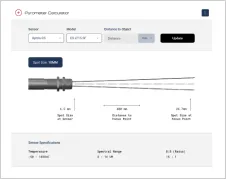
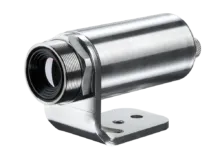
The Optris CT LT pyrometer is an exact, compact infrared sensor designed for point temperature measurement. In laminated glass production, it is typically used to measure the temperature of the glass surface in real time, serving as a reference point for the overall process. The CT LT is beneficial in smaller production lines or areas where only spot measurements are needed. It provides accurate temperature readings even in challenging environments with limited space for sensor placement. By offering continuous, non-contact temperature monitoring, the CT LT allows manufacturers to quickly identify and correct any deviations in temperature that could negatively affect the lamination process.
Achieving Consistent Lamination with Optris Infrared Solutions
Integrating Optris infrared cameras and pyrometers, such as the PI 640i, Xi 400, Xi 410, and the CT LT, into the laminated safety glass production process significantly benefits glass industry manufacturers. One primary advantage is the ability to achieve precise and consistent temperature control, which is essential for ensuring the high quality of laminated glass. Maintaining uniform heating across the entire glass surface, these devices help prevent common production issues such as uneven bonding or delamination.
The Optris PI 640i offers unparalleled thermal resolution, making it ideal for applications requiring detailed temperature mapping. This camera allows manufacturers to monitor large areas of the glass laminate with exceptional clarity, identifying any temperature fluctuations that could affect the bonding process. The camera’s high resolution ensures that even the smallest temperature variations are detected, allowing immediate process adjustments. This level of precision improves product quality and reduces the likelihood of production errors, saving time and resources.
The Xi 400 and Xi 410 infrared cameras provide a compact yet powerful solution for manufacturers with space constraints or more budget-sensitive projects.. Their ability to perform line scans through small openings allows them to monitor temperature distribution across the entire glass surface without needing a direct view of the entire laminate. This is particularly useful in complex production setups, where complete visual access to f the glass may be limited. The cameras’ autonomous operation capabilities also enable seamless integration into existing production lines, providing manufacturers with flexibility and ease of use.
The CT LT pyrometer adds another control layer by offering pinpoint temperature measurements at critical points in the production process. Its small size and accuracy make it a valuable tool for continuous monitoring, ensuring that specific areas of the glass reach the required temperatures. The CT LT’s ability to provide real-time feedback helps manufacturers avoid costly production errors, reduce waste, and enhance overall process efficiency.

Recommended Products
















Other Glass Applications




Talk to us about your IR Temperature Measurement Requirements
There are over 300 different pyrometer variants to choose from in the Optris infrared pyrometer portfolio each optimized for material, spot size, distance from the target, and environmental conditions. Fortunately, there is a trained engineer to phone or chat with to guide you through the process of choosing the perfect infrared sensor for your application.
The same support is available for the extensive IR camera product line.
