


Noncontact Infrared Temperature Control in Aluminum Rolling Process
Challenge
Accurately measuring aluminum strip temperature is difficult due to low, variable emissivity and high reflectivity, especially during cold rolling where temperature control is critical to product quality and equipment protection.
Solution
By targeting the wedge formed in the aluminum coil, infrared cameras capture temperature at a virtual blackbody point, minimizing emissivity issues and background interference for accurate real-time readings.
Benefits
- Enables continuous monitoring for consistent product quality and process stability
- Reduces risk of equipment damage through precise temperature tracking
- Supports real-time control and automated adjustments to maintain optimal conditions
- Simplifies integration into existing systems with minimal additional components
- Enhances process transparency with reliable thermal documentation for analysis and traceability
Challenges in Infrared Temperature Measurement for Aluminum Rolling Processes
The aluminum rolling process is critical to the aluminum manufacturing industry, where precise temperature measurement is essential for ensuring high-quality product output and protecting equipment. This process, which produces aluminum coils through various methods, including cold rolling, direct casting, and continuous casting, plays a fundamental role in determining the final properties of the material.
During this process, aluminum slabs or billets undergo either cold working or hot working, depending on the desired material characteristics. Cold rolling increases the strength and hardness of the aluminum by altering its microstructure, though it also makes the material more brittle. Conversely, hot working, conducted at temperatures between 260 °C and 510 °C depending on the alloy, maintains the aluminum’s ductility by preventing work hardening. As the aluminum passes through the rolling mill, its temperature varies significantly—from an initial preheating stage at around 200 °C, rising to approximately 450 °C upon entering the rolling mill, and then dropping below 100 °C as it exits.
One of the key challenges in this process is the accurate temperature measurement of aluminum, particularly due to its highly reflective surface. Aluminum is notoriously difficult to measure with infrared cameras because of its low emissivity and high reflectivity in the infrared spectrum. Especially when polished or bright, aluminum’s emissivity is very low, typically ranging from 0.02 to 0.1 for long-wavelength infrared devices. This low emissivity means that aluminum emits very little infrared radiation compared to other materials, making it challenging for long-wavelength infrared cameras to provide accurate temperature readings. Additionally, aluminum’s emissivity can vary with temperature, further complicating precise measurement. Short-wavelength infrared cameras, which typically have a higher evaluated temperature range, are often incompatible with the temperatures used in aluminum processing, making them less suitable for these applications.


Harnessing the Wedge Effect: Overcoming Emissivity Challenges in Infrared Temperature Measurement
One effective way to address the emissivity challenge in temperature measurement is to focus on the point where the coil forms a wedge, creating a nearly enclosed cavity for infrared radiation. In the deepest part of this wedge, the cavity acts as a virtual blackbody, with a stable emissivity close to one. This approach, known as the wedge method, is particularly effective for measuring the temperature of polished steel strips, which typically have a low emissivity of around 0.37. The wedge naturally forms within the coiled strip, making it an optimal location for accurate temperature readings.
The wedge effect in infrared thermography explains why surfaces within a wedge-shaped structure exhibit higher apparent emissivity compared to flat surfaces. This increased emissivity results from multiple reflections of infrared radiation within the wedge, where the radiation bounces off the walls, enhancing the likelihood of absorption and re-emission. This process creates an environment that closely mimics a perfect blackbody, with an emissivity approaching 0.998, regardless of the material’s natural emissivity. This phenomenon significantly reduces the impact of emissivity variations and background radiation on temperature measurements. For the wedge effect to be effective, the depth of the wedge must significantly exceed its opening.
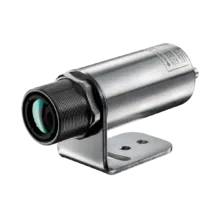
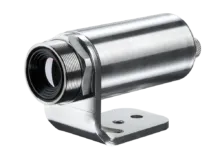
The Xi410 infrared camera can autonomously leverage the wedge effect despite being a long-wavelength device. The thermal imager can accurately identify the highest temperature by configuring a region of interest (ROI) in the PIXConnect software to capture the maximum temperature within the wedge of the aluminum coil. The Xi410 can then transmit thermal data directly to a programmable logic controller (PLC) via analog outputs or digital interfaces, ensuring precise and reliable temperature monitoring in real-time.
Achieving Optimal Aluminum Cold Rolling with Affordable Temperature Monitoring Using Wedge Measurement Techniques
To roll high-grade products the decisive difference is the precise temperature control. If the required temperatures are precisely maintained, the product quality can be assured and damages to the roll stand will be avoided. This application is suitable for the wedge measurement technique used at the coiler or between the roll and the product during the rolling process, which eliminates the challenges posed by low temperatures and variable emissivity, and also eliminates background reflection influences. This allows the manufacturer to implement continuous process temperature monitoring. It ensures that the system consistently tracks temperature variations throughout the production process, allowing for real-time adjustments and supporting the documentation of process and tool temperatures, providing insights into the production process, and enabling closed-loop control for automated adjustments that maintain optimal conditions and prevent deviations.
Any Optris long wavelength camera can exhibit the wedge effect to accurately measure the strip temperatures in cold rolling and coiling applications. In this application, the autonomous thermal imager from the Xi Series provides multiple interface options, enabling the camera to be easily integrated into new or existing process control systems. Unlike other solutions from the competition, there is no need for special software or unique sets of wavelengths in this challenging application, as Optris infrared cameras will measure the wedge effect at an affordable price.

Recommended Products








Other Metal Applications



Talk to us about your IR Temperature Measurement Requirements
There are over 300 different pyrometer variants to choose from in the Optris infrared pyrometer portfolio each optimized for material, spot size, distance from the target, and environmental conditions. Fortunately, there is a trained engineer to phone or chat with to guide you through the process of choosing the perfect infrared sensor for your application.
The same support is available for the extensive IR camera product line.
