


Optimizing Metal Casting with Fixed Short-Wavelength Infrared Cameras
Enhancing Metal Casting Quality and Cost Savings in Foundries with Optris Infrared Cameras
Challenge
In casting, dip thermocouples degrade quickly due to extreme heat, corrosion, and mechanical wear, leading to unreliable temperature data, frequent replacements, and increased process costs. Inaccurate readings can cause casting defects, wasted energy, and reduced efficiency due to poor control over molten metal temperature during pouring.
Solution
Short-wavelength infrared cameras enable accurate, real-time temperature monitoring of molten metal without physical contact. By capturing thermal images of the liquid metal stream, they allow immediate corrective actions, improve process control, and ensure consistent quality, while reducing reliance on disposable sensors and minimizing operational interruptions.
Benefits
- Reduces scrap rates by preventing defective or incomplete castings
- Lowers operational costs by eliminating frequent thermocouple replacements
- Enhances worker safety through non-contact temperature monitoring
- Improves casting quality with accurate, real-time thermal imaging
- Enables seamless automation and better control via continuous thermal data
Overcoming the Limitations of Dip Thermocouples in the Casting Process
In metalworking, casting is a process where metal is heated until it becomes a liquid, then poured into a mold, typically using a crucible. The mold contains a negative impression of the desired shape, allowing the metal to solidify as it cools, forming the final casting. This method is particularly advantageous for producing complex shapes that would be challenging or uneconomical to create using other techniques.
Casting offers benefits like high surface quality and minimal material waste, but it also involves significant costs, primarily for mold tooling and the energy required to heat the metal. As the metal cools in the ladle, its temperature gradually decreases with each successive pour. If the temperature drops below a critical threshold, the casting may be incomplete, leading to defects. In such cases, the defective part must be discarded, wasting the energy invested in the process. To prevent this, it is crucial to monitor the casting temperature and halt the process if the molten metal drops below the optimal range. If necessary, the metal can be reheated to ensure a successful casting.
Traditionally, companies purchase dip thermocouples as consumables every year, but these thermocouples fail quickly under high temperatures. Thermocouples often fail in the casting process due to the harsh conditions they face, including extreme heat, corrosive environments, and physical wear from repeated use. The intense heat can cause the thermocouple’s protective sheath to degrade or melt, exposing the sensor elements and leading to failure. Continuous immersion in molten metal can also result in chemical reactions that deteriorate the thermocouple’s materials, further shortening its lifespan. Additionally, mechanical damage from handling and the aggressive casting environment contributes to frequent failures, making thermocouples less reliable for consistent, long-term temperature measurement.


Short-Wavelength Infrared Cameras: The Key to Accurate Liquid Metal Temperature Measurement
An infrared camera is essential for optimizing the casting process, offering real-time temperature monitoring that ensures molten metal stays within the optimal range. This level of precision significantly reduces the risk of defects such as incomplete casts or solidification shrinkage. By capturing detailed thermal data, the camera allows for immediate adjustments, preventing costly errors and minimizing material waste. It also monitors the cooling rate, promoting uniform solidification and high-quality surface finishes.
Measuring liquid metal temperature with long-wavelength infrared cameras presents challenges due to the metal’s high reflectivity and varying emissivity, which can result in inaccurate readings. Short-wavelength infrared cameras, like the PI 1M or Xi 1M, provide a more effective solution by leveraging metal’s higher emissivity at shorter wavelengths and the exponential increase in infrared radiation at these wavelengths. This approach yields more accurate temperature measurements, ensuring reliable data even in the most demanding metal-casting environments.
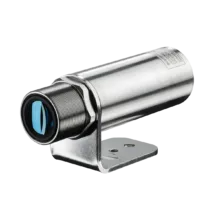
The PI1M infrared camera excels in non-contact measurement of the pouring liquid metal stream, enabling precise monitoring throughout the casting process. Its high image quality and ease of automation make it an ideal choice for integration with programmable logic controllers (PLCs), which can process thermal data to determine optimal stopping points in the process. This seamless integration of technology enhances both the efficiency and safety of metal casting. The camera can also be equipped with a cooling jacket to protect it from dust and dirt, allowing it to function reliably in ambient temperatures up to 315 °C. The built-in fail-safe function provides additional security by detecting issues such as broken cables, computer shutdowns, or software crashes, making it a robust safety feature.
Moreover, the infrared camera’s imaging capability far surpasses that of handheld pyrometers, as it automatically identifies the hottest or coldest temperatures within the measurement field. Unlike pyrometers, which only measure a single point, the infrared camera ensures operators do not miss critically low temperatures, offering a comprehensive and accurate temperature profile that enhances process control and product quality.
Affordable Infrared Imaging: The Competitive Edge of Optris Cameras
In this application, a metal casting foundry was searching for a more effective solution to accurately measure the temperature of liquid metals while reducing its reliance on expensive consumable dip thermocouples. The company had purchased thousands of these thermocouples annually, leading to significant ongoing expenses. Their objective was to find a safer, more cost-effective method to optimize the quality of molten metal while achieving substantial savings on consumables. Introducing the PI1M infrared camera allowed the plant to significantly reduce its dependence on disposable thermocouples. The PI1M offers precise, non-contact temperature measurement, which enhances safety and efficiency and improves metal quality, leading to considerable cost savings. Thanks to the competitive pricing of the Optris infrared camera, the investment reached break-even within the first year of use.
Optris provides infrared cameras at highly competitive price points, making advanced thermal imaging technology accessible to the metal industry. Despite their affordability, Optris infrared cameras maintain high quality and performance standards. This cost-effectiveness and advanced functionality balance enables businesses to integrate sophisticated thermal monitoring into their processes, and increase the level of automation without exceeding budget constraints. The affordability of Optris infrared cameras also positions them as an attractive option for companies looking to upgrade from traditional temperature measurement methods to more advanced, non-contact solutions.

Recommended Products








Other Metal Applications





Talk to us about your IR Temperature Measurement Requirements
There are over 300 different pyrometer variants to choose from in the Optris infrared pyrometer portfolio each optimized for material, spot size, distance from the target, and environmental conditions. Fortunately, there is a trained engineer to phone or chat with to guide you through the process of choosing the perfect infrared sensor for your application.
The same support is available for the extensive IR camera product line.
