


Improving Glass Syringe Production Through Infrared Thermal Imaging
Enhancing Quality in Glass Forming Through Infrared Measurement
Challenge
Maintaining precise temperature during continuous glass syringe forming is difficult due to rapid processing speed and narrow thermal tolerances. Deviations cause premature deformation or improper reshaping, leading to defects and waste, making real-time, accurate temperature control essential for product quality and process reliability.
Solution
By integrating infrared imaging and spot temperature measurement, manufacturers gain real-time insight into critical forming zones. Continuous monitoring ensures glass remains within ideal temperature ranges throughout production, enabling timely adjustments that prevent defects and stabilize product consistency during high-speed processing.
Benefits
- Reduces defective syringes by maintaining optimal temperature during forming stages
- Minimizes material waste through early detection of thermal deviations
- Enhances process stability with real-time, non-contact monitoring
- Lowers downtime by allowing prompt adjustments before faults develop
- Supports consistent high-quality output with improved thermal control
Temperature Control Challenges in Glass Syringe Manufacturing
The production of glass syringes involves complex temperature control during the glass-forming process. Initially, a glass tube is heated to temperatures reaching up to 1100 °C before moving through various stages of the production line. During these stages, the glass is subjected to multiple processes, including reshaping through the application of precise force, such as creating a narrowing or a thickened area, which requires accurate temperature control. The movement of glass tubes is continuous, as any delay or incorrect temperature can lead to premature deformation, creating defective syringes.
A significant challenge in this process is maintaining the glass within an optimal temperature range. If the glass is too cold, it will not reshape correctly, resulting in product defects. On the other hand, if the temperature is too high, the glass may deform before reaching the intended forming stage, leading to waste. The speed of the process also contributes to the difficulty, as glass tubes pass through the critical forming area within seconds, leaving minimal room for error.
Temperature measurement is essential to ensure the quality of the final product, as accurate monitoring during heating and forming phases directly impacts production efficiency. The precision required in this process is why temperature control using infrared technology has become a critical solution in glass syringe manufacturing.


Seamless Integration of Infrared Sensors in Production Lines
Infrared temperature measurement technology is critical for optimizing glass syringe production. The PI 640i G7 infrared camera is ideal for this application, offering high-resolution thermal imaging at 640 x 480 pixels with a frame rate of up to 125 Hz. This allows for real-time monitoring of the glass-forming process, ensuring precise temperature measurements between 150 °C and 1500 °C. The camera’s wide field of view (up to 111°) enables the simultaneous monitoring of multiple glass tubes in the production line, providing critical data to ensure each tube is within the optimal temperature range.
The PI 640i G7 features a spectral range of 7.9 µm, specifically designed for glass industry applications, where accurate surface temperature readings are crucial. Its thermal sensitivity of 80 mK at 650 °C ensures that even the smallest temperature deviations are detected, helping to prevent deformation of the glass tubes during the forming process. The infrared camera is connected via USB, with optional extensions for Ethernet and Power over Ethernet (PoE) interfaces, making it easy to integrate into existing production environments for seamless monitoring and control.
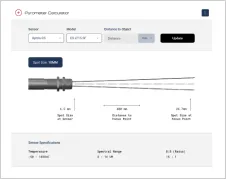
Complementing the infrared camera, the CT G5 pyrometer provides point temperature measurements with impressive accuracy. This pyrometer is capable of measuring temperatures from 100 °C to 1650 °C, making it perfect for both the initial heating phase and the final forming stages. The CT G5 offers an optical resolution of 20:1, allowing precise targeting of specific areas on the glass, and its fast response time of 80 ms ensures real-time adjustments can be made.
Together, these infrared measurement tools provide a comprehensive solution for maintaining optimal conditions during glass syringe production, offering seamless integration and accurate monitoring.
Improved Product Quality Through Precise Temperature Control
The implementation of the PI 640i G7 infrared camera and the CT G5 pyrometer in glass syringe production offers considerable advantages. The ability to monitor temperatures in real time can significantly reduce the number of faulty syringes previously caused by incorrect temperature settings during the molding process. With these tools, syringe manufacturers can detect even small temperature deviations, ensuring that each glass tube is processed within its optimal range, minimizing scrap and improving overall product quality.
The thermal imaging capabilities of the PI 640i G7, with its 640 x 480 pixel resolution and high frame rate, enable the detection of even minor variations in surface temperature, which can be critical in preventing premature deformation. This level of precision leads to a consistent, high-quality product and reduces downtime by allowing operators to make adjustments before defects occur. Additionally, the CT G5 pyrometer’s point measurement feature, with a temperature range extending to 1650 °C, ensures accurate readings at critical points in the production line, further optimizing the process.
The integration of these infrared solutions not only improves product quality but also lowers operating costs by reducing material waste and production inefficiencies. Optris stands out as a reliable partner due to the unique features of its infrared technology, such as the line scan function with the PI 640i G7 and peak hold signal processing in the CT G5, which are tailored to high-temperature glass applications. These features, combined with the flexibility of the software solutions provided, make Optris the ideal choice for manufacturers seeking to enhance their glass syringe production lines.

Recommended Products









Other Pharmaceutical & Medical Applications





Talk to us about your IR Temperature Measurement Requirements
There are over 300 different pyrometer variants to choose from in the Optris infrared pyrometer portfolio each optimized for material, spot size, distance from the target, and environmental conditions. Fortunately, there is a trained engineer to phone or chat with to guide you through the process of choosing the perfect infrared sensor for your application.
The same support is available for the extensive IR camera product line.
