


Advanced Temperature Control in Lithography with CSmicro Infrared Sensors
Integrating Infrared Temperature Control into Semiconductor Manufacturing
Challenge
Accurate temperature control is essential in optical lithography to ensure consistent photoresist application, curing, and patterning. Temperature variations can cause defects in the layer thickness and final pattern, negatively affecting semiconductor performance and reliability. Non-contact, precise, and uniform temperature measurement directly on the wafer surface is therefore critical.
Solution
Infrared sensors measure wafer surface temperature without physical contact, enabling accurate, real-time monitoring during lithography. Long-wave spectral pyrometry precisely detects temperature distribution directly on the wafer surface, even within confined manufacturing spaces, ensuring homogeneous photoresist application, optimal curing conditions, and improved overall semiconductor quality.
Benefits
- Ensures consistent photoresist thickness, enhancing pattern accuracy and semiconductor reliability.
- Minimizes defects caused by temperature fluctuations, improving overall product yield and quality.
- Allows precise, non-invasive measurement in tight spaces, preserving manufacturing process integrity.
- Provides immediate temperature feedback for dynamic control, stabilizing production conditions efficiently.
- Enhances uniformity in wafer processing, significantly boosting throughput and operational efficiency.
The Crucial Role of Temperature in Semiconductor Optical Lithography
Optical lithography is a process used in the manufacturing of integrated circuits. It begins with applying a photosensitive material, known as photoresist, onto the substrate. A photomask containing the desired pattern is then positioned over the photoresist, and light is shone through the photomask, exposing specific areas of the photoresist. These exposed areas undergo a chemical change, becoming either soluble or insoluble in a developer solution. After development, the pattern is transferred onto the substrate through etching, chemical vapor deposition, or ion implantation.
Lithography involves several critical steps in which absolute temperature and temperature uniformity play a significant role. Initially, the wafer is cleaned and coated with a light-sensitive layer called photoresist. This photoresist layer must be applied and then cured to remove solvents, a highly sensitive process to temperature variations. Maintaining a homogeneous temperature distribution is essential to achieving a uniform layer thickness. Precise knowledge and control of the surface temperature are required to ensure consistency and quality.
Once the photoresist is applied and cured, UV light is projected onto the wafer through a mask containing the desired pattern. The areas of the photoresist exposed to the UV light undergo a chemical change. The wafer is then developed to reveal the pattern, with the unprotected material removed by etching.
Maintaining accurate temperature control throughout this process is crucial. Any deviation can lead to defects in the pattern, affecting the performance and reliability of the final semiconductor devices. Therefore, temperature management is integral to lithography and overall semiconductor manufacturing.


Temperature Control in Lithography with CSmicro Infrared Sensors
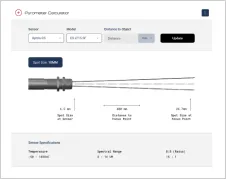
To avoid interfering with the sensitive manufacturing process, the wafer’s surface temperature must be measured without direct contact. Maintaining a uniform temperature distribution is essential to achieve a homogeneous layer thickness of the photoresist, and this must be measured directly on the object. A pyrometer with a long-wave spectral range (8 µm -14 µm) is used for this purpose. Given the typically tight space conditions, the sensor must be as compact as possible to ensure it can be positioned correctly, ideally perpendicular to the wafer surface.
The CSmicro, the most compact infrared sensor series with the smallest sensor head, is ideal for this application. Manufactured by Optris, the CSmicro series stands out due to its robust design and high precision. It features a miniaturized sensor head that can be easily integrated into confined spaces, making it perfect for semiconductor manufacturing environments. The CSmicro sensors are capable of measuring temperatures ranging from -40 °C to 1030 °C, providing flexibility for various stages of the manufacturing process.
Additionally, the CSmicro sensors have a fast response time, ensuring real-time temperature monitoring and control. This rapid feedback is critical for maintaining the tight temperature tolerances required in lithography. The temperature signal is transmitted to the PLC via an analog signal, allowing seamless integration into existing process control systems. The CSmicro’s advanced optics and high-quality calibration guarantee accurate and reliable measurements, contributing to improved process stability and product quality in semiconductor manufacturing.
Smallest Sensing Head allows Accurate and Efficient Temperature Monitoring in Lithography
To avoid interfering with the sensitive manufacturing process, the wafer’s surface temperature must be measured without direct contact. Maintaining a uniform temperature distribution is essential to achieve a homogeneous layer thickness of the photoresist, and this must be measured directly on the object. A pyrometer with a long-wave spectral range (8 µm -14 µm) is used for this purpose. Given the typically tight space conditions, the sensor must be as compact as possible to ensure it can be positioned correctly, ideally perpendicular to the wafer surface.
The CSmicro, the most compact infrared sensor series with the smallest sensor head, is ideal for this application. Manufactured by Optris, the CSmicro series stands out due to its robust design and high precision. It features a miniaturized sensor head that can be easily integrated into confined spaces, making it perfect for semiconductor manufacturing environments. The CSmicro sensors are capable of measuring temperatures ranging from -40 °C to 1030 °C, providing flexibility for various stages of the manufacturing process.
Additionally, the CSmicro sensors have a fast response time, ensuring real-time temperature monitoring and control. This rapid feedback is critical for maintaining the tight temperature tolerances required in lithography. The temperature signal is transmitted to the PLC via an analog signal, allowing seamless integration into existing process control systems. The CSmicro’s advanced optics and high-quality calibration guarantee accurate and reliable measurements, contributing to improved process stability and product quality in semiconductor manufacturing.

Recommended Products









Other Semiconductors Applications




Talk to us about your IR Temperature Measurement Requirements
There are over 300 different pyrometer variants to choose from in the Optris infrared pyrometer portfolio each optimized for material, spot size, distance from the target, and environmental conditions. Fortunately, there is a trained engineer to phone or chat with to guide you through the process of choosing the perfect infrared sensor for your application.
The same support is available for the extensive IR camera product line.
