



Black Body
The Black Body is a model for a body that completely absorbs electromagnetic radiation of any wavelength. It follows that it shows no transmissivity and no reflectivity for any radiation.
Of all conceivable thermal radiation sources, a black body emits the greatest possible radiant power for each wavelength at a specific temperature, regardless of the angle of radiation. It forms the basis for understanding the physical principles of non-contact temperature measurement. Infrared thermometers are calibrated using black bodies of known temperatures. As a Lambert radiator, its radiance is not polarized and is independent of the direction of radiation. For real measurement objects, a correction parameter called emissivity must be set to minimize measurement errors. This parameter describes the difference in emission behavior between the ideal black body and the real measurement object.
Planck’s Law of Radiation describes the spectral specific radiation M(𝑇,λ) of the black body into the half-space as a function of its temperature 𝑇 and the observed wavelength λ.
[math]M(T,λ)=\frac{2\pi hc^{2}}{\lambda_{5}}\frac{1}{e^{hc/\lambda kT}}- 1[/math]
This relationship illustrates the observation that every body with a temperature above absolute zero (0 K) emits electromagnetic radiation. For higher temperatures, more radiant power is emitted for each wavelength. The emission has a maximum for a certain wavelength λmax. Since infrared radiation thermometers detect this radiation and calculate the object temperature, taking into account their spectral sensitivity this law represents the most basic relationship for non-contact temperature measurement.
Two important relations can be derived from this:
1.) By integrating the spectral radiation intensity over all wavelengths from zero to infinity, one obtains the value for the total radiation power emitted by the body with a surface A. This relation is referred to as the Stefan Boltzmann Law.
[math]P(T) = σ· A · T^{4} [W · m^{-2}][/math] with [math]σ = 5,67 · 10^{-8} [Wm^{-2}T^{-4}][/math]
The total emitted radiation of a black body in the entire wavelength range increases in proportion to the fourth power of its absolute temperature.
2.) From an extreme value observation of Planck’s radiation law, however, it can be deduced that the wavelength value for the maximum emission shifts to smaller values at higher temperatures. Wien’s Displacement Law describes this relation:
[math]\lambda_{max} · T = 2898 µm · K[/math]
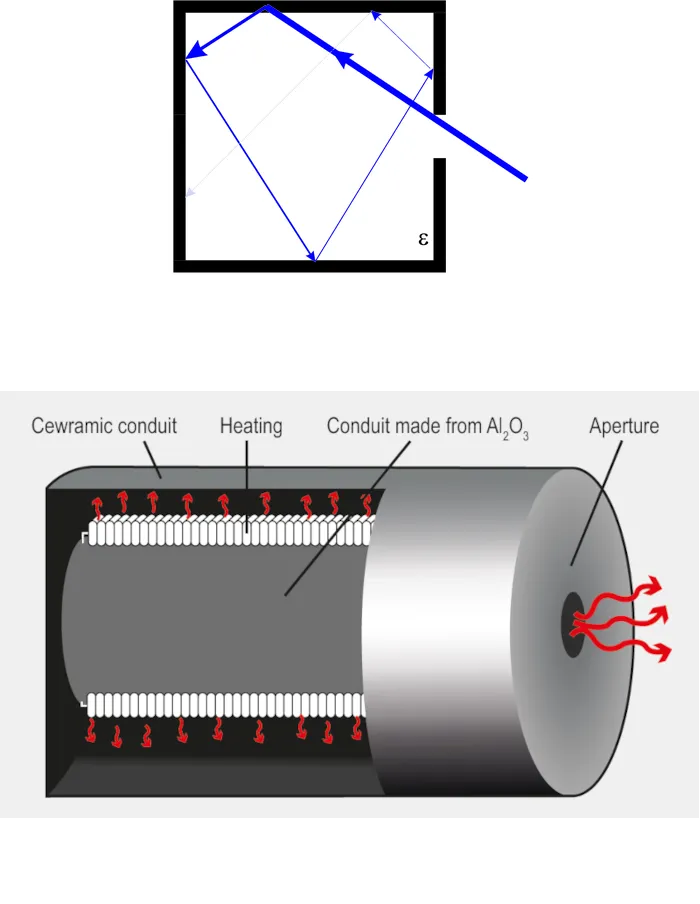
Since it is very difficult to develop a coating with minimal reflectivity over a wide wavelength range that is also temperature-resistant and cost-efficient, it has not been possible to produce a black body radiator simply by applying a specific coating. The best possible technical realization of a black body is a homogeneously tempered hollow body with a small opening compared to the inner diameter. This setup effectively absorbs any radiation entering the hole through internal multiple scattering, fulfilling conditions for minimum transmissivity and reflectivity. In practice, a homogeneously heated cylinder with a beveled bottom, with a length-to-diameter ratio of around 5 and a high-emissivity surface, is the best solution. Achieving complete temperature homogeneity is challenging, especially at high temperatures.
Back to Lexicon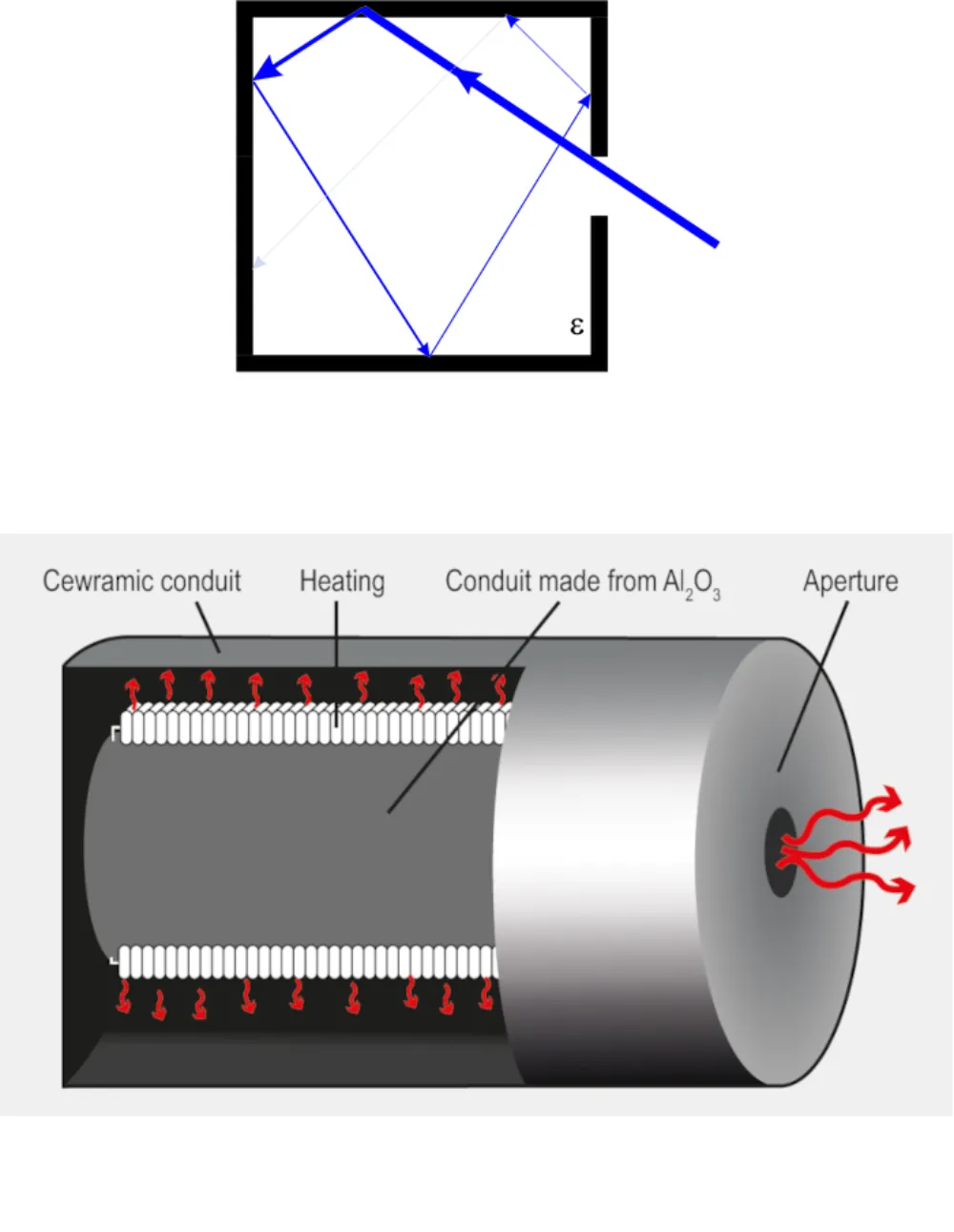
Recommended Products






Talk to us about your IR Temperature Measurement Requirements
Our Infrared Temperature Measurement experts can help you find the right Optris product for your application.
