


Diagonal Field of View (DFOV)
DFOV, which stands for Diagonal Field of View, refers to the total angular extent of the observable scene in both the horizontal and vertical directions, measured diagonally across the camera’s field of view. Knowing the coverage area that an infrared camera can capture at a given distance is essential. The DFOV can be calculated using the camera’s horizontal and vertical fields of view (HFOV and VFOV) and applying the Pythagorean theorem. A larger DFOV means the camera can capture a wider area, which benefits applications requiring broad surveillance or monitoring of large scenes. Conversely, a smaller DFOV is useful for focusing on smaller, more detailed areas. The DFOV is influenced by the infrared camera’s lens and the size of the sensor. A lens with a shorter focal length or a larger sensor will result in a wider DFOV, while a longer focal length lens or a smaller sensor will produce a narrower DFOV.
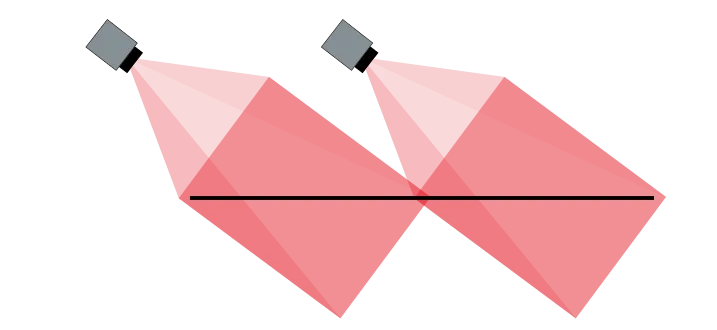
The Diagonal Field of View is particularly important for line scanner applications. Infrared cameras are often capable of performing line scan measurements, which are particularly useful in various industrial applications where continuous monitoring of moving objects or surfaces is required and the field of view is partially occupied. Line scan measurement is a technique where the infrared camera captures temperature data along a single line across the target surface. As the target moves, these line scans are combined to create a comprehensive thermal image of the entire surface. This method is highly efficient for monitoring continuous processes such as conveyor belts, manufacturing lines, or any other application where the object of interest is in constant motion. This line can go across the full field of view and have random shapes. Therefore, the DFOV is the largest scan line width possible for the infrared camera.
The DFOV impacts the resolution and level of detail that can be captured in the scanned image. A well-optimized DFOV ensures that the scanner provides sufficient detail across the entire width of the scanned area. This balance between field of view and resolution, and considering the MFOV, is critical in line scanner applications to ensure that small defects or variations are not missed.
Consider a line scanner used in manufacturing to monitor a large sheet of material, such as metal, paper, or textiles, transported on a conveyor belt. The DFOV determines how much of the sheet’s width can be scanned in one pass. If the DFOV is too narrow, the infrared camera can miss material, and details cannot be resolved. A well-optimized DFOV ensures that the entire width is covered efficiently, capturing high-resolution thermal images that reveal any defects or irregularities.
Back to Lexicon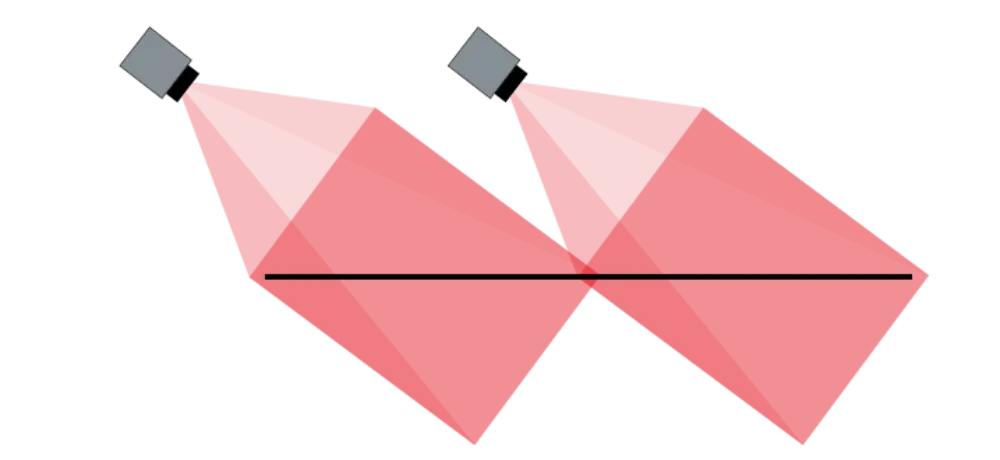
Recommended Products




Talk to us about your IR Temperature Measurement Requirements
Our Infrared Temperature Measurement experts can help you find the right Optris product for your application.
