


NETD: Noise Equivalent Temperature Difference
The NETD is a contribution to the measurement uncertainty of any infrared temperature measurement technology, the cause of which is the device noise. It determines the lower limit of the reproducibility of the measurement results.
Smaller values lead to more accurate measurements. In the case of infrared cameras, smaller NETD values also lead to a less noisy and higher-contrast image, in which even small temperature differences are more visible. In industry for imagers, a temperature resolution of 100 mK is sufficient for most applications.
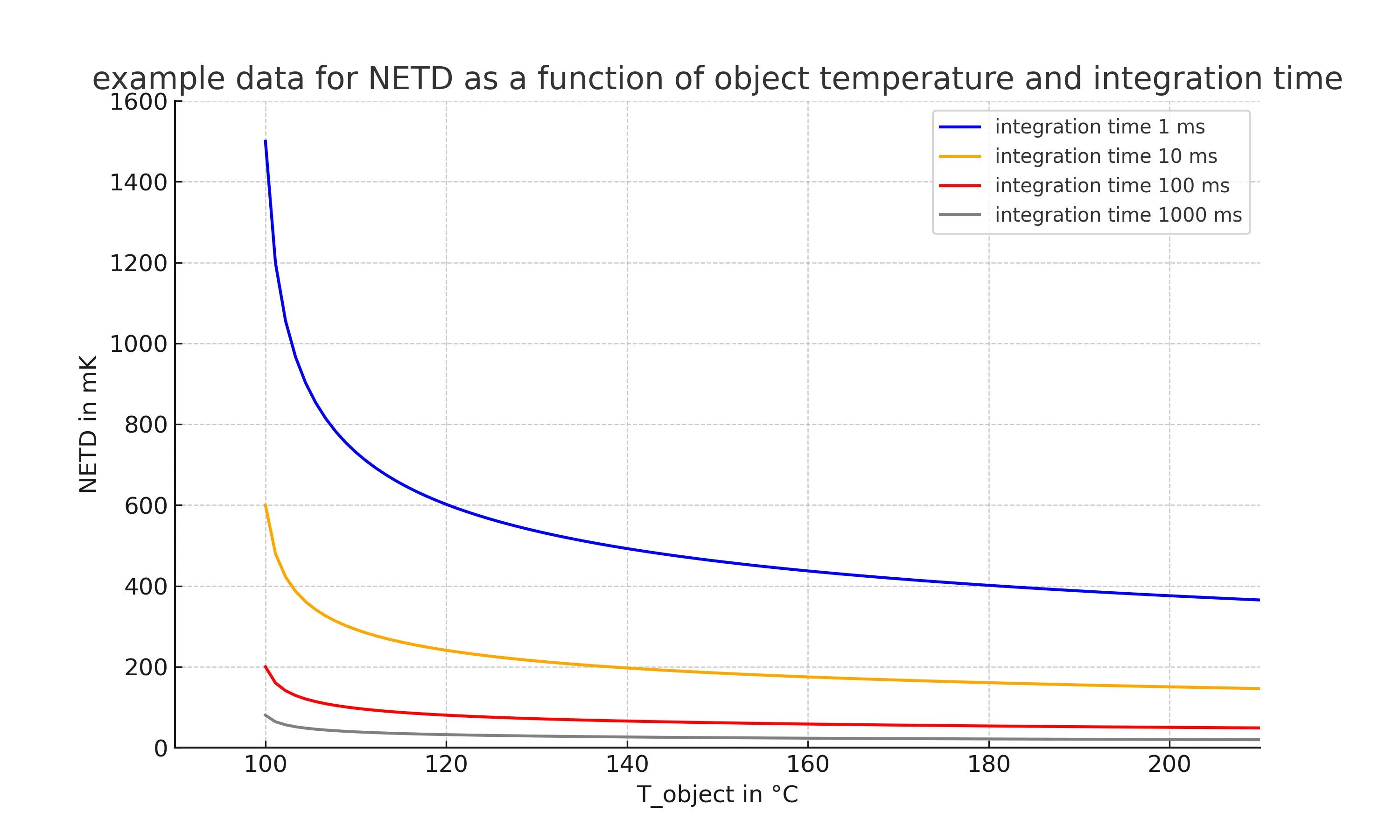
The acronym NETD stands for noise equivalent temperature difference. This indicates that the relationship between the digitized noisy detector signal and the calculated temperature, which is also noisy, is usually highly non-linear. As a consequence, the NETD depends strongly on the signal strength, i.e. on the object temperature and the emissivity of the object. The NETD is proportional to the inverse of the emissivity. For example, the NETD doubles with an emissivity of 0.5. It is usually highest at the beginning of the temperature measuring range and decreases with a higher target temperature.
In the case of pyrometers, the NETD is the simple standard deviation (confidence level of 68.3%) of 100 rapidly consecutive temperature readings at a constant object temperature. This means that under constant measurement conditions, the subsequent measured values will vary within an interval of +/- 3*NETD with a probability of 99.7%. For infrared imagers, the NETD is not the same for all detector elements. The value given here is close to the mean value of the NETD values of all detector elements. For more details see VDI guideline 5585.
Further, the NETD depends on integration time and may depend on ambient temperature. The noise is highly dependent on the particular signal processing. The signal-to-noise ratio can be improved with a longer integration time but at the expense of the response time of the device.
To achieve both a low NETD and a high response speed, Optris offers the “Smart Averaging” mode for its pyrometers, which can be configured via the user software. The two parameters Averaging Time and Smart Averaging Threshold are set. The noise of the measured values is reduced within the specified averaging time. However, the incoming measurement signal is still evaluated internally at the highest speed. If the Smart Averaging Threshold is exceeded due to a rapid signal jump, the processed measurement signal jumps to the new signal level and the measured values are averaged again from then on.
If not stated otherwise all values given in Optris documentation are stated in mK and are valid when the ambient temperature is 23 °C +/- 5 °C und with an emissivity setting of 1.000.
Back to Lexicon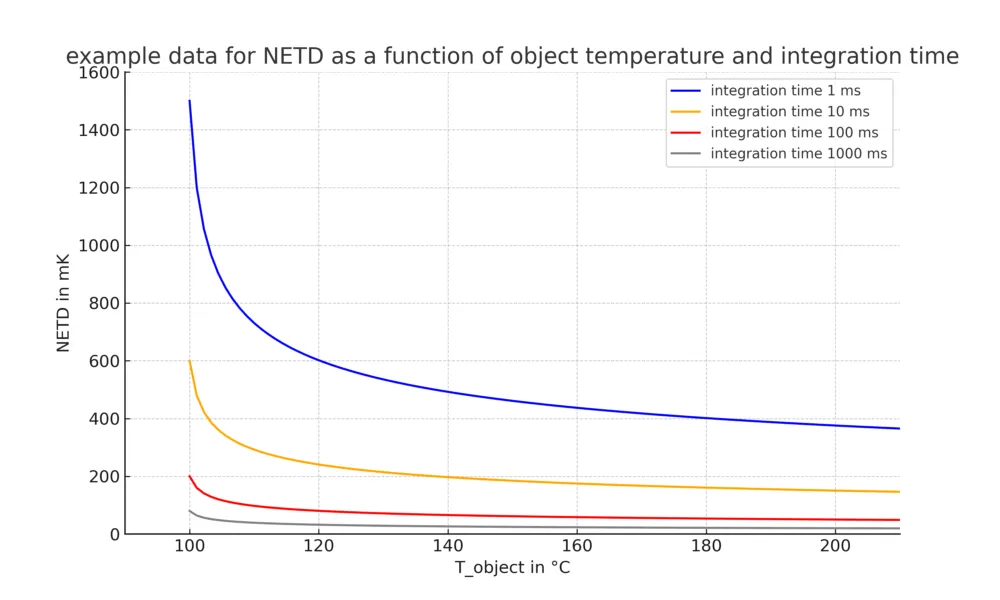
Recommended Products











Talk to us about your IR Temperature Measurement Requirements
Our Infrared Temperature Measurement experts can help you find the right Optris product for your application.
