


Optical Resolution
Optical resolution is a crucial specification parameter for temperature measurement and indicates the ability to resolve an object with sufficient accuracy. A small FOV (field of view) of a measuring device is associated with a small measuring spot size and a higher optical resolution of the target. In temperature measurement applications, high optical resolution ensures that all necessary temperature information from the target is captured precisely, facilitating effective temperature monitoring and control.
From a technical point of view, optical resolution is linked to the optics system of the measurement device and the detector size for a pyrometer or the sensor’s pixel size for a thermography camera. Both together define the optical resolution for the temperature measurement application.
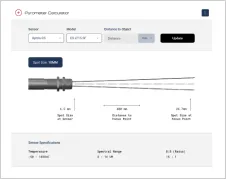
Related to a pyrometer application, optical resolution is the ability to measure the temperature of a specific area accurately. The measurement spot size varies with the measurement distance of the pyrometer, leading to the use of the distance-to-spot size ratio (D:S ratio). In most cases, it is advantageous to have a small spot size (and therefore a large D:S ratio). The pyrometer can detect small targets even at larger distances and ensure professional temperature measurement. However, precise alignment of the device is required, often realized by laser or video sighting, handling the advanced optical resolution.
It is essential to ensure the object is larger than or at least equal to the measurement spot. Only ratio pyrometers can measure objects smaller than the measuring spot without causing inaccuracies leading to a signal attenuation of 80% or even 90%. To ensure accurate measurement, always check the measurement spot size of a pyrometer at a given distance and use a FOV or spot size calculator app.
For a thermal imaging camera, optical resolution is often referred to as spatial resolution. It indicates the distance at which two point-like objects can be separately detected and thus resolved, described by the Rayleigh criterion. This criterion depends on the F-number of the optics and measurement wavelengths. Often, the Modulation Transfer Function (MTF) is used to describe the optical resolution for imaging systems. The Rayleigh criterion represents a MTF of 9%. Below this value, the objects can no longer be distinguished.
For temperature measurement applications using thermography cameras, optical resolution is often defined by the instantaneous FOV, representing the smallest target size that can be resolved at a specific distance. The IFOV represents the measurement spot generated by a single pixel of the detector array, while the whole FOV represents the full sensor array. For optimal object sampling, an object distance of two times the IFOV is recommended.
For high-accuracy temperature measurement in the field of thermal imaging, the target size should be at least equal to the MFOV. A typical MFOV value is described by 3×3 pixels, which corresponds to 3 times the IFOV. For further details, please check the FOV calculator.
Back to Lexicon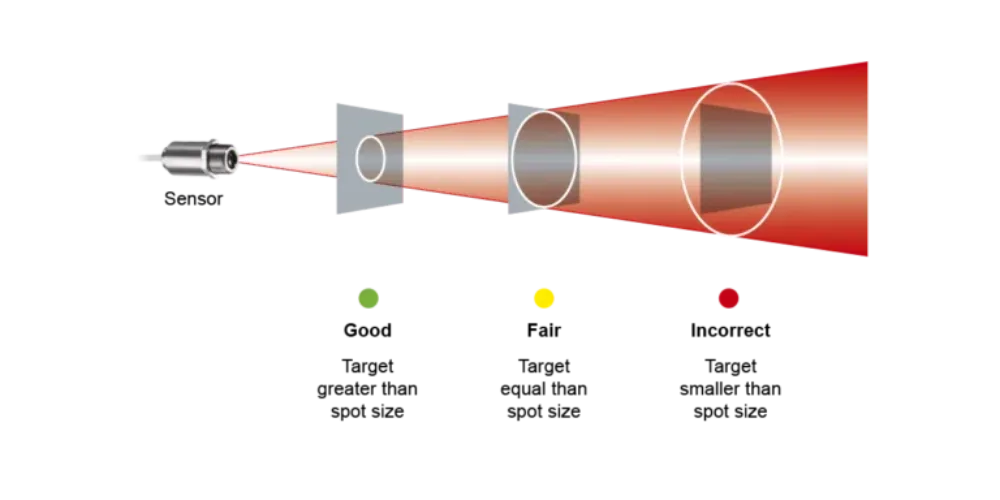
Recommended Products













Talk to us about your IR Temperature Measurement Requirements
Our Infrared Temperature Measurement experts can help you find the right Optris product for your application.
