


Scatter
Scattering is a phenomenon in which light deviates from a predicted path and changes its straight trajectory. This is an important issue in the field of temperature measurement, as scattered light can reach the detector and introduce additional signal strength. This can lead to lower temperature accuracy and reduced image quality in the thermal imaging camera.
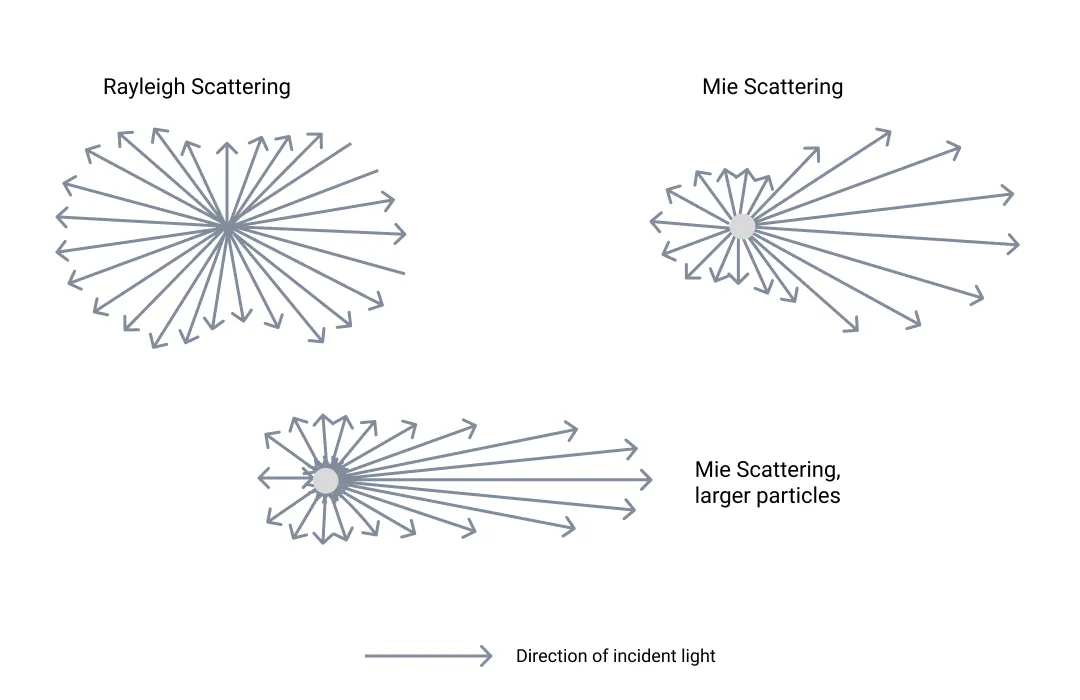
There are two main types of scattering: surface scattering and volume scattering. In volume scattering, the light interaction takes place inside the material or describes the interaction with elements of the atmosphere. Rayleigh scattering occurs with small particles, where the radiation is influenced by an atom or molecule that is smaller than the wavelength used (r << λ). This happens when the thermal radiation is emitted from the object and passes through the atmosphere before being detected by the measuring device. Rayleigh scattering is significantly reduced by using longer wavelengths. For this reason, thermal imaging technology is well suited to firefighting applications when dust and smoke occur.
For slightly larger particles (r < λ), Mie scattering is generated, which has a more forward-directed scattering. This applies to aerosols such as dust or pollution in the atmosphere. This scattering is more dependent on the wavelength of the scattered light and tends to scatter it more evenly. For particles whose size is larger than the wavelength, the scattering is more geometric. Geometric volume scattering is often referred to as optical scattering if it is related to the optical path within the optical system. When passing through bulk material such as optical windows or lenses, the light is scattered by inhomogeneities in the lens material or unwanted material defects such as impurities. During the interaction, most of the light is scattered in the forward direction, but a certain amount is scattered in the opposite direction.
Surface scattering is generated directly on the surface between two different media. It is caused by irregularities or micro-roughness of the surface. This is directly related to the manufacturing quality of the optical element. The higher the roughness of the surface, the more light is scattered and diffusely reflected.
Both surface scattering and volume scattering (within the device) lead to a loss of contrast in the thermal image. In this case, a modulation transfer function (MTF) can be a way to quantify this phenomenon of scattered light. In addition, light scattering leads to a misleading temperature measurement called the Size of Source Effect (SSE). This happens because the radiation propagates from the initial scattering points and can be reflected by the internal optical elements or mechanical tube parts. In this case, surface and volume scattering lead to a higher temperature measurement and must be reduced to a minimum. This requires high-quality lens material, a highly effective anti-reflective coating, precise machining of the lens, special knowledge of optomechanical design, and precise calibration of the measuring device.
Back to Lexicon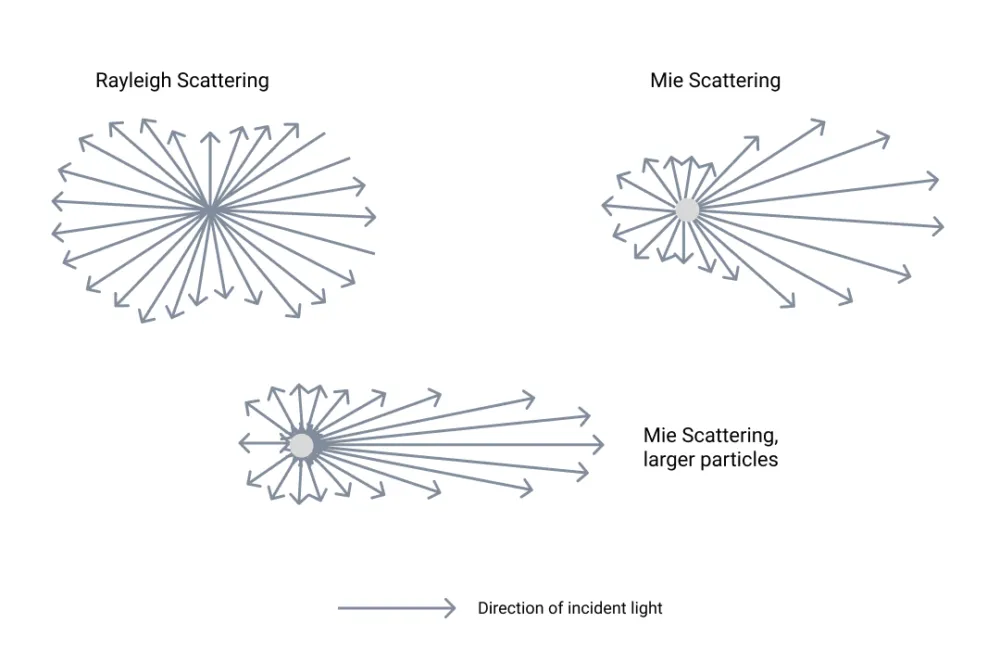
Recommended Products







Talk to us about your IR Temperature Measurement Requirements
Our Infrared Temperature Measurement experts can help you find the right Optris product for your application.
