


Spectral Range
The spectral range is a band chosen from the total electromagnetic spectrum, ranging from high-energy gamma radiation through the visible wave range to large-scale radio waves. For temperature measurement applications, this range typically encompasses the visual, the near-infrared, mid-infrared, and long-wave infrared bands.
In the context of optics and imaging, the term “spectral range” refers to the specific part of the electromagnetic spectrum that an imaging system or sensor is sensitive to. This range determines what type of electromagnetic waves the system can detect and utilize for imaging purposes. In general, it is influenced by the sensitivity of the detector, the atmospheric windows, and the targeting temperature range of the application.
For most temperature measurement applications, the spectral range starts from the visible waveband to the long-wave infrared (LWIR) band. The reason lies in the physical behavior of the emitting source. The temperature of a blackbody source can be related to a peak wavelength of the emission spectrum. According to Wien’s displacement law, wavelength and temperature are linked, so that the respective temperature results in a wave range for the measuring device. Most interesting for thermal imaging is the measurement of room temperature targets. To enable an infrared camera to measure this temperature, the spectral range is set to the LWIR 8 µm – 14 µm waveband.
The spectral range is not only dependent on temperature range but also influenced by the atmospheric windows. For physical reasons—such as the absorption of infrared radiation in the air—the different detectors for non-contact temperature measurement are limited to the partially well-working wavebands.
Understanding the spectral range is essential not only for designing effective thermal imaging systems but also for interpreting the images they produce. Different wavelengths provide different information about an object’s thermal properties. By choosing the appropriate spectral range, thermographers can optimize their imaging based on specific application needs, enhancing the ability to diagnose, monitor, and manage heat-related characteristics in diverse scenarios. This selective sensitivity is what makes the spectral range a fundamental concept in thermography and broader imaging technologies.
Back to Lexicon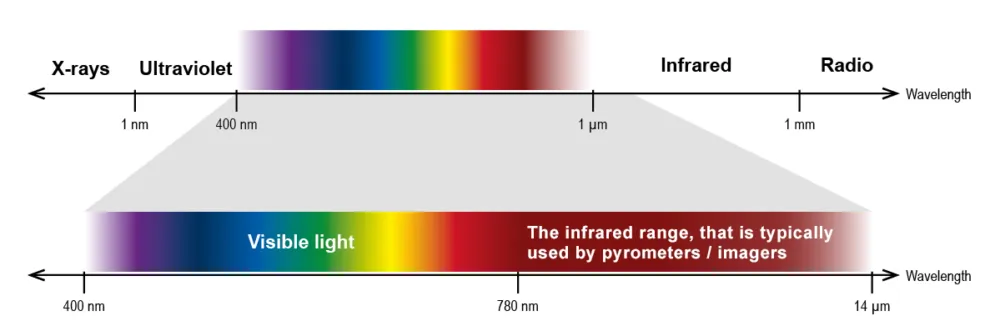
Recommended Products









Talk to us about your IR Temperature Measurement Requirements
Our Infrared Temperature Measurement experts can help you find the right Optris product for your application.
