


Spot
A spot is a more realistic concept to overcome the geometric notion of the focal point. Instead of a perfect point-like distribution, larger spots are obtained, which are referred to as Airy-discs or Airy-patterns. This is the smallest spot in which light can be focused by an optical system with a circular aperture. The generating of an Airy disk distribution on the sensor is the best case of the imaging system and describes an optical system operating without aberration and is limited only by the diffraction of light.
As light passes through the circular aperture it forms an Airy disk characterized by concentric rings with decreasing intensity from the center outwards. Most of the energy is well centered and is localized inside the first zero point, it is given by:
\[r0=1.22∙λ∙N\]
where λ is the applied wavelength and N is the F-number of the optics. The encircled energy up to the first zero is 84%. This leads to the diameter of spot size:
\[d=2.44∙λ∙N\]
As the formula shows, the diameter of the Airy disk strongly depends on the used measurement wavelength. For thermal imaging application the waveband of 8-14 µm is commonly used. That indicates for thermography larger spot sizes compared visual imaging applications. If the detector with its typical spectral response wavelength is chosen, only the F-number can control the size of the diffraction distribution.
The spot size is strongly connected to the optical resolution. Resolving two points by a diffraction-limited optical system depends on their Airy pattern which must have at least the distance of \[r_0\]
The Modulation Transfer Function (MTF) quantifies this by comparing the contrast at different target sizes and distances. A system achieving a MTF greater than 9% between two points is considered to have resolved them. For practical application one can use the description of the IFOV where objects of that size must have a distance of two times the IFOV to gain a suitable optical resolution. That means for sampling the image of the two objects an unilluminated pixel between the two spots is always necessary.
An optical system which is generating an Airy disk is called a diffraction-limited system. This is the best performance reachable if waveband and F-number are fixed. In practice, aberration of the optics and opto-mechanical tolerances must be considered and are influencing the imaged distribution on the sensor strongly. Quantitatively it is given as the Strehl Ratio (SR), named after Karl Strehl. It compares the intensity of the real spot or aberrated pattern with the ideal Airy disk. A SR greater than 0.8 indicates a system is nearly diffraction-limited, while less than 0.8 suggests significant aberration impacts.
In applications requiring extremely high optical resolution, such as microscopy or lithography, shorter wavelengths are used to reduce the Airy disk diameter and enhance detail visibility. For thermography application using an infrared camera the waveband is usually 8-14µm especially for measuring objects at room temperature (T=300 K). That behavior is described by Planck’s law characterize emission spectrum of a blackbody. Measuring low temperatures with a competitive NETD of the infrared camera is often limited to the LWIR. Recognize this reason, the only way to improve Airy disk diameter is an advanced thermal imaging optics to gain a high optical resolution of the target.
Back to Lexicon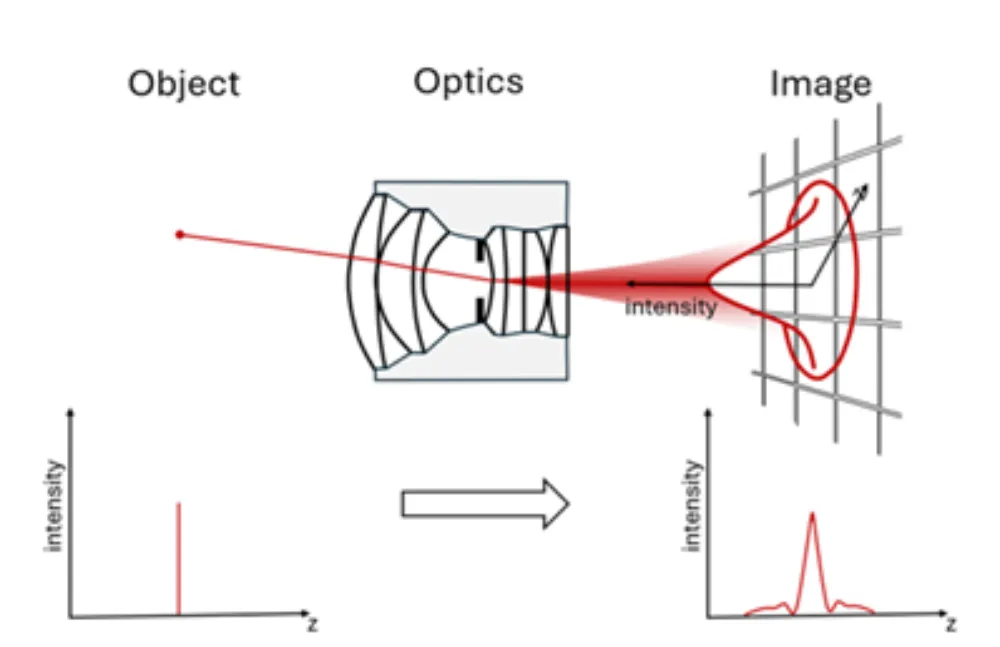
Recommended Products











Talk to us about your IR Temperature Measurement Requirements
Our Infrared Temperature Measurement experts can help you find the right Optris product for your application.
