



Transmissivity
Alongside absorptivity and reflectivity, transmissivity is one of the three basic material properties of objects that characterize the interaction of electromagnetic radiation with matter. It is the ratio of the radiation intensities after and before propagation through the object under consideration. τ = I/I_0 (see the image). As it is a ratio variable, it is unitless. Transmissivity can take on values between 0 and 1, where 0 means that no transmission takes place at all, while the value 1 means that all the radiation is transmitted. The transmissivity τ is connected to the reflectivity ρ and the absorption α according to the equation:
1 = α + ρ + τ
According to this correlation, the transmissivity therefore depends on the proportion of radiation not reflected at the material surface or absorbed when passing through the material.
For many measurement objects, the transmission can be considered negligible. However, thin plastic films or window materials can exhibit significant transmissivity. The transmissivity depends very much on the wavelength under consideration. Standard window glass, for example, is transparent for visible light, but completely opaque for wavelengths greater than 5 µm. This means, that for infrared cameras with a spectral sensitivity of 8 µm to 14 µm, no standard glass can be used for the optics or protective windows, but special optics made of silicon or germanium must be used. These, in turn, are non-transparent in the visible spectral range.
Back to Lexicon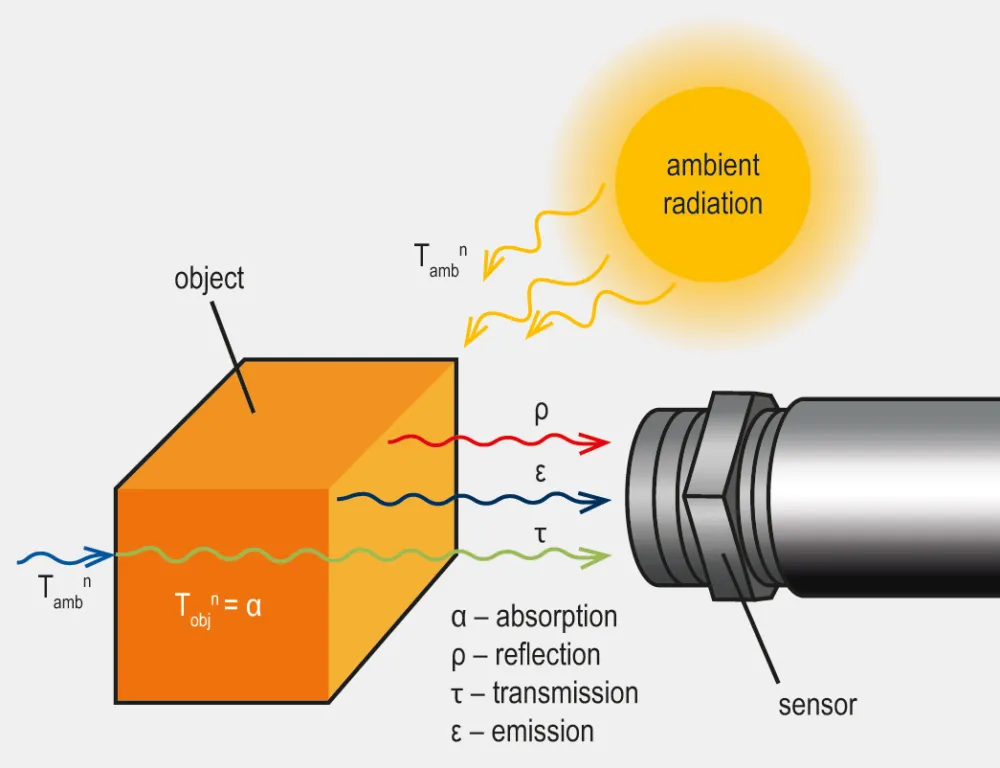
Recommended Products















Talk to us about your IR Temperature Measurement Requirements
Our Infrared Temperature Measurement experts can help you find the right Optris product for your application.
