


Wien’s Displacement Law
Wien’s displacement law states that the wavelength at which a black body emits its maximum radiation is inversely proportional to its absolute temperature 𝑇. This means that if the temperature of the emitter doubles, the wavelength of the peak radiation is halved. For instance, the color of a glowing object changes from reddish at 1000 K to whitish at 3000 K and to bluish at 10000 K, as the temperature increases and the peak wavelength becomes shorter.
This relationship can be derived from the radiation model of a black body and depends solely on its temperature, according to Planck’s radiation law.
The thermal radiation of a black body consists of electromagnetic waves that form a broad spectrum of wavelengths. The intensity of the radiation is distributed across different wavelengths according to Planck’s radiation law. This distribution is characterized by a peak at a certain wavelength, which depends on the temperature of the black body. According to Wien’s law, this peak shifts towards shorter wavelengths as the temperature of the black body increases. Wien’s law allows us to calculate the magnitude of this shift.
The key point is that the higher the temperature of the black body, the shorter the wavelength at which the object emits its maximum radiation. Therefore, at room temperature, we find only invisible infrared rays, while hot iron emits red to dark red rays, and molten iron emits in the white light range.
Wien’s displacement law can be derived from Planck’s radiation law, which describes the spectral power density of the radiation of a black body. To derive Wien’s displacement law, one must locate the peak of Planck’s radiation function. This is achieved by differentiating the function for the wavelength using the product rule and setting the derivative to zero. After mathematical derivation, the formula of Wien’s law is obtained, which describes the wavelength at which the maximum radiation intensity lies.
[math] \lambda\max = \frac{2897,8 \mu m K}{T} [/math]
Back to Lexicon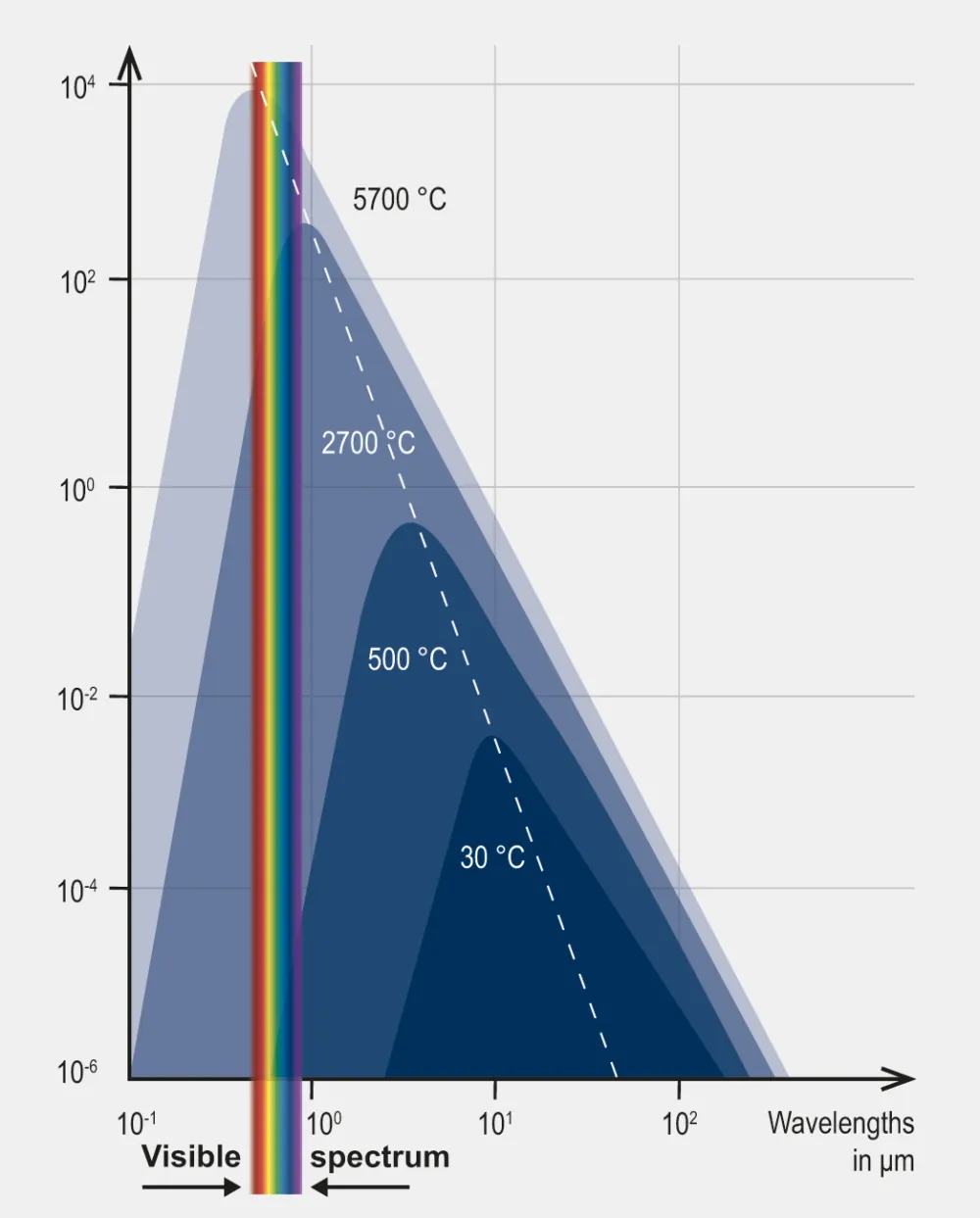

Recommended Products











Talk to us about your IR Temperature Measurement Requirements
Our Infrared Temperature Measurement experts can help you find the right Optris product for your application.
